
Nothing can escape a black hole—except, potentially, its secrets.
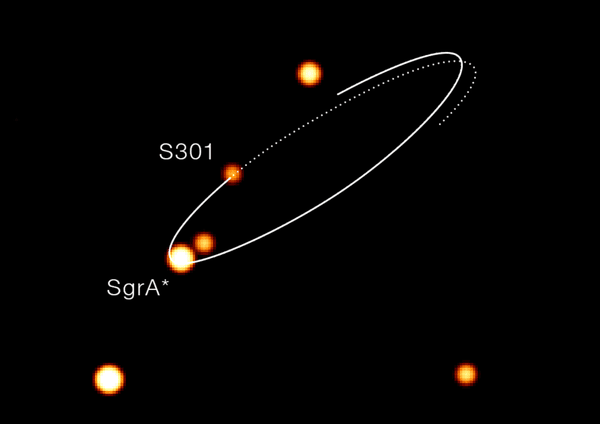
Astrophysicists have spied a unique star called S301 whipping around Sagittarius A* (Sgr A*), the supermassive black hole at the Milky Way’s heart. S301 orbits Sgr A* so tightly that the star’s trajectory should be bent by the black hole’s rotation. Detailed in a paper published today in Nature, this discovery should help researchers do something never done before: discern a black hole’s spin from the motion of a single star.
Found using sophisticated instruments on the European Southern Observatory’s (ESO’s) Very Large Telescope Interferometer (VLTI) in Chile, S301 is also the fastest star ever observed in the Milky Way. At its closest approach to Sgr A*, the star hits 25,000 kilometers per second—about 8 percent of the speed of light. At that speed, you could get from New York City to Los Angeles in about a sixth of a second (if you’d be willing to show up a little disheveled).
On supporting science journalism
If you're enjoying this article, consider supporting our award-winning journalism by subscribing. By purchasing a subscription you are helping to ensure the future of impactful stories about the discoveries and ideas shaping our world today.
Despite their deserved reputation for unleashing numerous mind-bending physical paradoxes, black holes are thought to be among the universe’s simplest objects, only possessing three fundamental properties: mass, charge and spin. And while astronomers have managed to estimate the spins for some black holes, measuring this spin directly hasn’t been possible for lack of a suitable probe. S301 could change that.
“Nature is telling us that, just a footstep away compared to other black holes, there is a path toward directly checking whether a black hole is rotating,” says Stefan Gillessen, an astrophysicist at the Max Planck Institute for Extraterrestrial Physics (MPE) in Garching, Germany, and one of the study’s authors.
Although in principle, a black hole could possess no spin, scientists have long assumed that, in practice, they all spin—Sgr A* included—like most everything else in the universe. And a spinning black hole drags spacetime along with it (a phenomenon known as the Lense-Thirring effect), altering the orbits of surrounding stars. But this effect weakens rapidly in proportion with distance: get twice as far away, for instance, and the orbital shaping drops eightfold. Even S2, a star that gets near enough to Sgr A* to let astronomers test key tenets of Einstein’s general theory of relativity, never swoops sufficiently close to allow measurements of the black hole’s spin.
S301 gets way more intimate with Sgr A*. In only 8.7 years, it completes an orbit of the black hole—the shortest orbit ever measured around the galactic center. At its closest point, the star is about as close to the black hole as Saturn is to the sun. That arrangement may not seem claustrophobic at first, but considering Sgr A*’s mass is roughly 4.3 million times that of our star, it’s basically spitting distance.
Finding a star like S301—let alone studying it—across the 26,000 or so light-years separating it from our solar system is no small feat and pushed even ESO’s mighty VLTI close to its limits. With the VLTI, “we are combining four telescopes, and on top of that, we’re using laser guide stars for each and every one of them,” says study co-author Reinhard Genzel, director of infrared and submillimeter astronomy at MPE, who shared the 2020 Nobel Prize in Physics for pioneering studies of Sgr A*. “That’s an enormous amount of technology, but that has allowed us to fetch the star, which otherwise you can’t.”
With an instrument called GRAVITY on the VLTI, the team first spotted S301 in the spring of 2023 and has tracked it ever since (later using GRAVITY’s upgrade, GRAVITY+). Subsequent analysis of archival observations from 2017 also turned up hints of the star. The study team suggests S301 was once one of two stars orbiting each other, a pair that drifted too perilously near to the Milky Way’s monstrous central black hole. The close encounter flung them apart. “The interaction gives one of the binary stars a lot of energy, and it escapes immediately from the Milky Way,” Genzel says. “The second star loses energy and gets stuck.”
As much as Genzel and his colleagues are itching for S301 to give them a eureka moment, this isn’t a sure shot. Astronomers quantify a black hole’s spin as any value between zero (no spin) and one (maximum possible spin, close to the speed of light), and the study assumes SgrA*’s spin will approach that greater extreme.
“If the spin is one—the maximum value it can be—you get a bigger signal than if it’s, like, 0.3,” notes Kareem El-Badry, a California Institute of Technology astrophysicist, who wasn’t involved in the study but checked the team’s calculations. “I wouldn’t be surprised if, in 10 or 15 years, we think we know the spin,” he says. “But I don’t think it’ll come only from this star. It’ll have to be a combination of multiple datasets.”
Dimitrios Psaltis, an astrophysicist at the Georgia Institute of Technology, who wasn’t part of the study team but is familiar with its work, concurs. Future success, he says, will be determined by more than what this lone discovery presently reveals. To definitively measure Sgr A*’s spin, observers will likely need not only for it to have “a very large spin” but also for that spin to be “pointing in the right direction,” Psaltis says. Then—and only then—“we might be able to see it.”
Still, both El-Badry and Psaltis are hopeful that additional stars as close as or even closer than S301 may yet be found—and that S301 itself may yet prove fortuitously aligned to disclose Sgr A*’s spin by itself. The star’s next closest passage to the black hole will occur in 2031. And soon even more formidable hardware will have the zooming star in its sights: Besides GRAVITY+ on the VLTI, the MICADO instrument on ESO’s upcoming Extremely Large Telescope will also monitor the star’s swooping orbital path across the next decade. That follow-up work, the new study’s authors say, may constrain S301’s trajectory just enough to bring the spin of Sgr A* within empirical reach at last.
“Maybe this will be the star that will do it,” Psaltis says. “But if not, it just tells you that if you look deep enough and long enough, you’re going to find things closer. And I think that’s what we’re all anticipating.”