
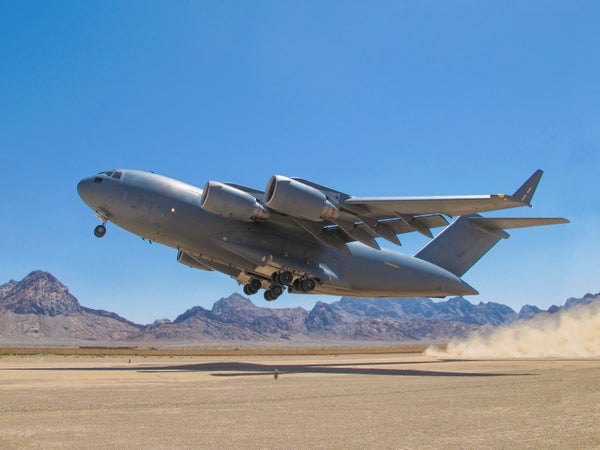
CLIMATEWIRE | One of the Air Force's largest airplanes may have to fly with smaller cargo loads due to climate change, according to new research published by the agency.
The C-17 Globemaster III is used to transport troops, tanks and other military equipment around the world. But the study — published in the journal Air & Space Operations Review — found that higher temperatures exacerbate what's known as "air density," which affects an aircraft’s ability to take off and maintain desired altitude.
As a result, C-17s may need to reduce payload weight by as much as 8.5 percent by 2039 under worst-case warming scenarios, researchers found. That figure could rise to nearly 30 percent by 2099.
On supporting science journalism
If you're enjoying this article, consider supporting our award-winning journalism by subscribing. By purchasing a subscription you are helping to ensure the future of impactful stories about the discoveries and ideas shaping our world today.
Air Force officials “should expect to sustain dramatic performance degradation to all aviation assets, most clearly evidenced by the decreasing thrust production that mandates reduced takeoff weight in strategic airlift platforms,” researchers Kaitlyn Benton and Timothy Leslie wrote in the paper, “Barriers to Force Projection: Climate Change and Aerial Forward Operability.”
All airplanes, notably commercial passenger jets, must factor air density into takeoff and flying conditions. But air transporters at the Defense Department, which must traverse entire continents and oceans, could be particularly affected by climate change, according to the researchers.
The study used climate warming projection data from 2020 to 2099 to estimate changes in “air density altitude” under various climate change scenarios. By applying mathematical models to the datasets, the researchers were then able to estimate how shifting “air density thresholds” affect a C-17’s performance.
Leslie, an associate professor of geography at George Mason University, said in an email that “increased density altitude has a negative effect on the performance of all types of aircraft, though elements such as the weight and engine of a particular airframe will determine how much difference a specific density altitude change causes.”
The same principles apply to commercial aircraft, as evidenced by passenger flight disruptions during periods of prolonged extreme heat in the Southwest, including this summer’s swelter.
But the C-17, nicknamed “the moose,” is no ordinary aircraft. It is equipped with four turbofan engines capable of producing 40,440 pounds of thrust each, with a maximum gross takeoff weight of 585,000 pounds, according to the Air Force. The maximum payload for a C-17 is 170,900 pounds — and it can carry one Abrams tank, 10 armored Humvees, two tractor-trailer trucks or 100 fully geared paratroopers, according to an Air Force description sheet.
Reprinted from E&E News with permission from POLITICO, LLC. Copyright 2023. E&E News provides essential news for energy and environment professionals.