
In the middle of a humid night in November 1997, two scientists and I donned waders and walked into the water of a half-acre test pond about 20 miles west of West Palm Beach, Fla. The researchers were there to set up egret decoys before the real birds flew over at dawn. I’d been warned about the snakes we might encounter while I was reporting on their research for this magazine [see “The Painted Bird”; February 1998]. Our flashlights illuminated the eyes of not too distant alligators. But despite the potential for venomous and/or crushing reptile bites, the most pressing safety concern explained my long sleeves and head netting—preventing the pinprick puncture of encephalitis-carrying mosquitoes.
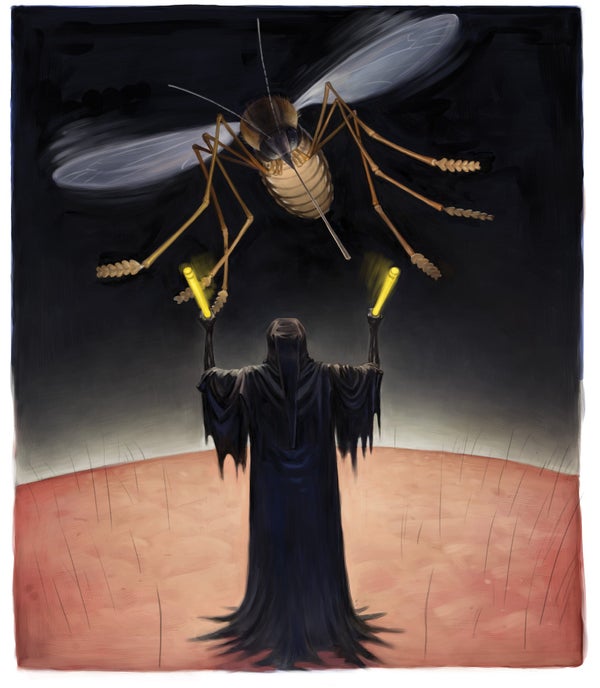
I was reminded of my 4 A.M. tromp upon the arrival of the new book The Mosquito: A Human History of Our Deadliest Predator. Most people are probably more frightened of sharks than they are of mosquitoes—it’s tough to get too worked up over something you can swat. But as author Timothy Winegard points out, sharks kill fewer than 10 people annually, whereas the average yearly mosquito-related death toll over the past two decades is about two million. Mosquitoes are the deadliest predator of people on the planet.
The runner-up killer of human beings is—you guessed it—human beings. In that same stretch, we’ve offed about 475,000 of our fellows on average annually, Winegard reports. Granted, it would be tough for 7.7 billion humans to outkill the 110 trillion mosquitoes that are alive at any time. That’s more than 14,000 of them for every person. In the Arctic during the summer, they can completely cover something (or someone) edible in a flash. “Ravenous mosquito swarms,” Winegard writes, “literally bleed young caribou to death at a bite rate of 9,000 per minute, or by way of comparison, they can drain half the blood from an adult human in just two hours.”
On supporting science journalism
If you're enjoying this article, consider supporting our award-winning journalism by subscribing. By purchasing a subscription you are helping to ensure the future of impactful stories about the discoveries and ideas shaping our world today.
Of course, human expiration via exsanguination by mosquito is exceedingly rare. “It is the toxic and highly evolved diseases she transmits that cause an endless barrage of desolation and death,” Winegard writes. He uses “she” because only females bite, attracted to us mostly by the carbon dioxide exhalations that they can detect up to 200 feet away. They also like really smelly feet. So if you think you can hide in plain sight by holding your breath, be sure to also wash between your toes before you pass out.
Of the more than 15 diseases mosquitoes transmit, the deadliest—malaria—has been sickening animals for an exceedingly long time. “Amber-encased mosquito specimens contain the blood of dinosaurs infected with various mosquito-borne diseases, including malaria,” Winegard writes. He notes that the 1993 movie Jurassic Park gets it wrong because the mosquito depicted as having supplied the dinosaur blood, and thus its DNA, is one of the few species for which blood meals are not required for reproduction. Indeed, that egregious error is what blew the movie’s verisimilitude for me.
The book claims that mosquito diseases played a critical role in the American colonists’ underdog win in 1783 against the British in the Revolutionary War. George Washington, himself a malaria sufferer, “had the advantage of commanding acclimated, malaria-seasoned colonial troops.” Meanwhile many British troops had never been exposed and were mowed down by the kill-buzz.
Washington was first in war, first in peace and the first of eight presidents to be afflicted with malaria, according to Winegard. The others were Lincoln, Monroe, Jackson, Grant, Garfield, Teddy Roosevelt and John F. Kennedy. Roosevelt caught his in the Amazon, and Kennedy got it in the South Pacific, but the first six all got the disease in the U.S. when malaria and yellow fever were still common here.
In 2018 Climate Central reported that higher temperatures could mean more “disease danger days,” in the temperature range that disease-carrying mosquitoes prefer. But take heart: “Climate change may also actually make some locations too hot for mosquito survival and disease transmission,” Climate Central acknowledged. Finally, some good news.