
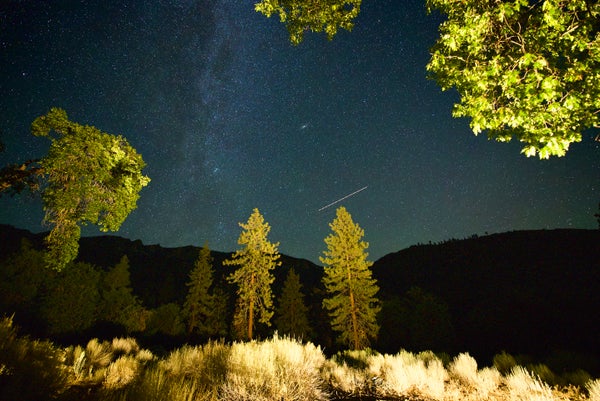
One of the best annual meteor showers, the Perseid meteor shower, is peaking now. The view this year may be slightly marred by a nearly full, waning gibbous moon—the phase that directly follows the full moon—in the sky. The Perseids, however, are often so bold and bright that the show is probably still worth checking out.
The meteors should be most visible after midnight local time and into the early morning hours before dawn from August 11 through August 13. The best times to see them will be between 2 A.M. and 3 A.M. local time. If you look in a dark patch of sky as far from the moon as possible, you should see fast streaks of light zip out from a patch of sky in the constellation Perseus, near the star Eta Persei.
The Perseids are known for being especially swift and bright, and in a good year viewers can expect to spot between 50 and 100 meteors in an hour. This year, with moonlight hampering dark skies, fewer than half the usual number of meteors could be visible. Still, 25 shooting stars an hour is worth waking up early for.
On supporting science journalism
If you're enjoying this article, consider supporting our award-winning journalism by subscribing. By purchasing a subscription you are helping to ensure the future of impactful stories about the discoveries and ideas shaping our world today.
As a bonus, Venus and Jupiter will be converging in the eastern dawn sky. The bright planets will be making their closest approach to each other between August 11 and August 13, when they will appear as a double star. This sight should be bright enough to spot even from light-polluted cities.
Meteor showers are caused when Earth passes through a trail of debris left by a comet or asteroid. As comets orbit the sun, they shed dust and small particles, which linger along their orbital path. More rarely, asteroids can create similar trails when they break into fragments following a collision with another space rock. When our planet crosses through such a path, these bits of rock and dust burn up in our atmosphere in a glorious spectacle. The Perseids and other annual meteor showers occur at the same time every year because Earth intersects with these debris trails at predictable spots along its orbit.
The Perseids originate from the particles left behind by Comet 109P/Swift-Tuttle. The comet itself is long gone, having moved on to the far reaches of the solar system by now. Its 133-year orbit around the sun last brought it through Earth’s cosmic neighborhood in 1992. But its detritus remains, giving rise to streaks that wow sky watchers every August.