New Issue: Orbital Catastrophe Ahead? Read Now

The Remarkable Timing of Seals

Some marine mammals can compare time periods and sense milliseconds of difference

Thomas Fuchs

Join Our Community of Science Lovers!

Many animals follow daily schedules or seasonal cycles—but can they distinguish, say, three seconds from 13? Some—bumblebees, pigeons, cats and others—are known to perceive passing time with some precision. After years working with the captive seals at the Marine Science Center at Germany's University of Rostock, biologist Frederike D. Hanke suspected the slippery mammals might be able to as well.

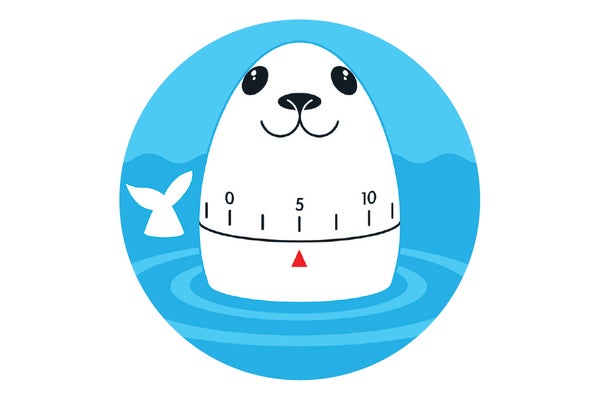
Hanke and her team tested her hunch on Luca, an 11-year-old harbor seal at the center. They displayed a white circle on a black computer screen for a period of three to 30 seconds, paused and then flashed the circle again. The researchers trained Luca to press one button if he thought the second display was longer and another if he thought both displays were of equal length. When he was correct, he enjoyed a tasty herring treat.

The team found that Luca could detect differences as short as 420 milliseconds. In other words, he could distinguish a three-second display from one lasting 3.42 seconds. His precision weakened as the pairs of display durations got longer, however. The experiment's results were recently published in Animal Cognition—the first time the ability to measure time has been reported for a pinniped.


On supporting science journalism

If you're enjoying this article, consider supporting our award-winning journalism by subscribing. By purchasing a subscription you are helping to ensure the future of impactful stories about the discoveries and ideas shaping our world today.


Seals may have evolved this skill to make split-second decisions while chasing fish or to identify vocalizations made at different rates by other seals, says Hanke, who is extending her investigation both to more seals and to acoustic stimuli.

Peter Cook, a psychologist at New College of Florida who has studied pinniped cognition and was not involved in Hanke's work, was most impressed by how easily Luca learned the testing task. It is common in psychophysics experiments such as this one for animals to need lots of practice—but Luca learned it in two training sessions. “Even though we're talking about very small discriminations, these short durations really pop for the seal,” he says. “It strongly suggests this is a very robust and well-tuned sense.”

Jason G. Goldman is a science journalist based in Los Angeles. He has written about animal behavior, wildlife biology, conservation, and ecology for Scientific American, Los Angeles magazine, the Washington Post, the Guardian, the BBC, Conservation magazine, and elsewhere. He contributes to Scientific American's "60-Second Science" podcast, and is co-editor of Science Blogging: The Essential Guide (Yale University Press). He enjoys sharing his wildlife knowledge on television and on the radio, and often speaks to the public about wildlife and science communication.

More by Jason G. Goldman
Scientific American Magazine Vol 316 Issue 1This article was published with the title “The Remarkable Timing of Seals” in Scientific American Magazine Vol. 316 No. 1 (), p. 17
doi:10.1038/scientificamerican0117-17

Subscribe to Support Independent Journalism

Great science journalism requires human expertise, time, effort and creativity. And it costs money. That’s why I and the journalists here at Scientific American hope you’ll join our community.

When you subscribe, you are supporting staff and freelance journalists who are passionate about telling science stories that are true, important and compelling. Our editors and reporters are often experts in their fields, which means they understand the nuances of big discoveries and can untangle the breakthroughs from the hype. With a subscription, you are also supporting rigorous fact-checking to ensure the words we publish are precise and accurate. And you’re supporting original illustrations, graphics and photos that bring you closer to an advanced laboratory, an ice sheet in Antarctica or a space mission in orbit. You’re helping us craft other types of high-quality journalism as well: Our newsletters are carefully written, edited and curated by staffers you have or will come to know and love. Our Science Quickly podcast is based on original reporting, collaboration with editors and scientists and exacting production.

Subscriptions keep this engine running so we can continue to deliver thoughtful, rigorous and independent science journalism to you. In an era of viral misinformation, this work is crucial. If you value what we do, I hope you’ll consider joining us as a subscriber

Thank you,

Jeanna Bryner, Editor in Chief, Scientific American

Subscribe