
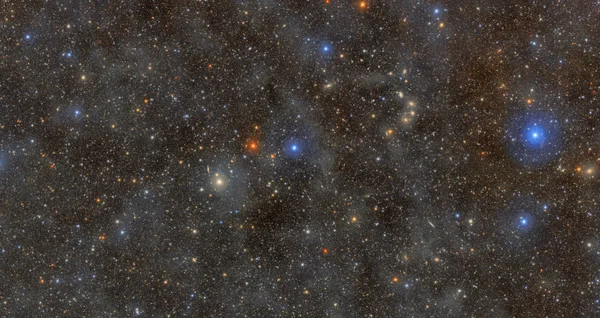
The biggest and best movie of the universe began production this week—at the new Vera C. Rubin Observatory in Chile, rather than in Hollywood.
This unique telescope is using the world’s largest digital camera to scan the entire southern sky every few nights, assembling what will become the most lavishly detailed time-lapse of the cosmos that humanity has ever envisioned. Rubin will look for undiscovered asteroids (including potentially hazardous ones heading toward Earth), unimaginably powerful cosmic explosions, and clues about the shadowy dark energy and dark matter that shape the universe.
Rubin opened its eye to the sky—an 8.4-meter-wide starlight-gathering mirror—about a year ago, but scientists have been testing and fine-tuning its optics since then. It officially began its 10-year Legacy Survey of Space and Time (LSST) on June 30. “It’s an amazing feeling—I’ve been working for over two decades on it,” says Željko Ivezić, head of the LSST. “It reminded me of the birth of my child. You wait, you wait and finally it materializes. We’ve been hoping for this night for quite a while.”
On supporting science journalism
If you're enjoying this article, consider supporting our award-winning journalism by subscribing. By purchasing a subscription you are helping to ensure the future of impactful stories about the discoveries and ideas shaping our world today.
The 3,200-megapixel camera, built by the SLAC National Accelerator Laboratory, can take an almost inconceivably high-definition image of the sky every 40 seconds or so, and Rubin’s giant mirror offers an enormous panoramic vista. “We have a large field of view about 100 times larger than that of similar telescopes and can scan 100 times faster,” Ivezić says. The data Rubin will amass in the next decade, he adds, would take any other observatory a millennium or more to capture.
The project, funded by the U.S. National Science Foundation and the U.S. Department of Energy, will focus on the changeable aspects of the heavens: sudden sparks of light, mysteriously vanishing stars, space rocks whizzing around the solar system and the dark-energy-driven accelerating expansion of the universe itself.
“After five to seven years, we will be in a position to tell apart two major hypotheses about dark energy,” Ivezić says. Either dark energy is a real phenomenon, causing the universe to grow bigger at a faster and faster rate, or there is no dark energy at all, and scientists have somehow misunderstood the laws of gravity at cosmic scales. “If we manage to answer this question, that will be the most fundamental result of Rubin and LSST.”
The observatory will also likely discover millions of new asteroids, including ones that may be on collision courses with Earth. And it has revolutionary potential for studies of what astronomers call transients: flashes of light that abruptly appear and quickly fade. These include supernovae and other cataclysms, such as gamma-ray bursts (GRBs), some of which arise from colliding black holes or neutron stars and are among the most powerful explosions in the universe. Many aspects of the physics underlying GRBs remain enigmatic—but Rubin’s potential for discovering entirely new types of transients could soon offer astronomers a wealth of additional cosmic mysteries to solve.