
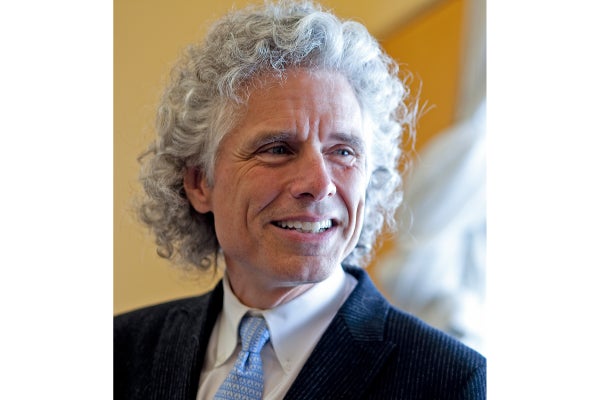
In thinking about the state of the world, it is easy to see the signs of backsliding, and to feel at least a little despair. And this, argues Harvard psychology professor Steven Pinker, is a profound error. In Enlightenment Now, he makes a powerful case that the main line of history has been, since the Enlightenment, one of improvement. We, the people of Earth, are better off now than we have ever been. And to fail to understand this—and the reasons why—is to put that very progress at risk. Pinker answered question from Mind Matters editor Gareth Cook.
If things are getting better, why does it feel like they are getting worse?
Improvements are gradual and not much to look at—children who don’t die and go to school, countries which are at peace, editorialists who aren’t jailed, women who can walk the streets in safety. Setbacks are sudden and photogenic— explosions, rampage shootings, refugees, tornados. Our sense of risk, cognitive scientists have shown, is driven by available images, not data. Also, there’s a market for gloom. Prophets, pundits, social critics, dystopian filmmakers and tabloid psychics know they can achieve instant gravitas by warning of doomsday. Those who point out that the world is getting better, even if they’re just reporting the data, may be dismissed as Polyannas and Panglosses.
We seem to be living in a time of political crisis, driven by polarization and rising economic inequality. Doesn’t this threaten the trends you discuss, and what gives you hope that the crisis will resolve?
There is never a time at which pundits don’t say we’re in crisis. It’s an easy formula: just list all the worst problems taking place anywhere in the world, and things will look more dire than they ever have. But past decades had much worse poverty at home and in the developing world, more and deadlier wars, nuclear escalations, a homicide rate twice as high as what we have now, homosexuality illegal in many states, and much else. It’s simply a mathematical fallacy to point to things going wrong now and to say life is getting worse: you have to compare it to life in the past.
On supporting science journalism
If you're enjoying this article, consider supporting our award-winning journalism by subscribing. By purchasing a subscription you are helping to ensure the future of impactful stories about the discoveries and ideas shaping our world today.
That having been said, there’s no question that the administration of Donald Trump is pushing back against the forces of progress. And Enlightenment Now is not a statement of “hope”—it’s a documentation of how far we’ve come and what we have to lose. The common question is a sign of how people cannot understand progress: they confuse historical facts with a sunny disposition.
The enlightenment idea of progress rests on the assumption that the stronger ideas—the ones best supported by the data—win out. Yet technology has delivered powerful ways of controlling people’s attention, and undercutting their trust in institutions, like journalism, that present the truth. Doesn’t this concern you?
Actually, the Enlightenment idea of progress is not a crystal ball or a reading of chicken entrails with a prognostication of what will inevitably happen in the future. It’s the conviction that that if we apply knowledge to increase human flourishing, then progress may happen. (If we don’t, it won’t.) Regarding technology’s supposed control of attention: social media, the panic du jour, gets blamed for everything that seems to be going wrong in the world. But the chronology is wrong: trust in institutions has been declining since its high point in the 1960s, and the trend toward political polarization predated Facebook and is driven far more by educational and occupational segregation.
As to “whether it concerns me”—once again, the question misunderstands the nature of progress and the point of Enlightenment Now. It’s not that we shouldn’t be “concerned” about new problems, as if human improvement were driven by a guardian angel or a fairy godmother. It’s precisely because people are concerned that progress can happen.
Having looked at the long arc of history, what gives you the most hope?
Rationality has a permanent advantage: it continues to be valid regardless of whether people believe in it. Also, as people from diverse backgrounds find themselves in the same boat, their values tend to go in the direction of universal flourishing, since it depends on nothing more—but nothing less—than their common humanity.