
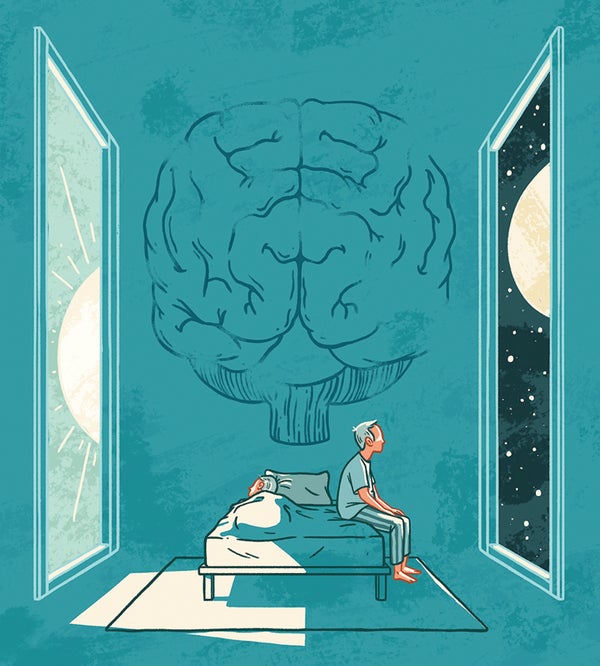
Among the many things that can shatter when Alzheimer's disease tightens its grip is the steady rhythm of the body's sleep-wake cycle. The problem is so common that one New York City nursing facility—the Hebrew Home at Riverdale—ran an all-night program for many years that took in afflicted community members for a dusk-to-dawn schedule of games, snacks, arts and crafts, and other activities so that their exhausted families could get some shut-eye.
Troubled sleep often begins long before dementia becomes apparent. In recent years research has been heating up on two key questions: Could disrupted sleep be a reliable early warning sign that the brain changes of Alzheimer's have begun? And even more exciting, though still speculative: Could the onset of the disease or its progression be slowed by treating sleep-related issues?
The brain pathology of Alzheimer's gets underway roughly 20 years before symptoms such as memory lapses and confusion become obvious. Scientists believe the fateful sequence goes something like this: beta-amyloid, a nerve cell waste product, starts to accumulate in the spaces around brain cells, eventually forming the telltale plaques of Alzheimer's. This is followed by a toxic buildup of tangles of tau protein inside nerve cells, first in the medial temporal lobe and then spreading to other regions. These changes lead to the death of neurons, loss of synapses and general atrophy seen in Alzheimer's-addled brains and the observable deterioration of cognition and behavior.
On supporting science journalism
If you're enjoying this article, consider supporting our award-winning journalism by subscribing. By purchasing a subscription you are helping to ensure the future of impactful stories about the discoveries and ideas shaping our world today.
Sleep, as it turns out, impacts both beta-amyloid and tau. Studies in humans and mice indicate that levels of both proteins fall during sleep. People who sleep poorly have higher levels of beta-amyloid and tau in their cerebrospinal fluid—even after a single bad night. What is perhaps more significant is what happens over the long term. PET scans show older adults with chronic sleep problems have more beta-amyloid deposited in their brain. Research published earlier this year in Science revealed that in a mouse model of Alzheimer's, lack of sleep promotes the spread of abnormal tau across certain brain regions. “It suggests that if there's a sleep disturbance night after night for some prolonged period, it could expose an individual to higher concentrations of these proteins and increase the risk of Alzheimer's,” says Brendan Lucey, one of the Science paper's authors and an assistant professor of neurology at Washington University in St. Louis.
A 2018 study provides evidence for this cumulative damage scenario. Using data on 124 older adults participating in a long-term National Institute on Aging (NIA) study, sleep researcher Adam Spira and his colleagues at Johns Hopkins University and the NIA found that people who complained of “excessive daytime sleepiness” at an average age of 60 were 2.75 times more likely to have beta-amyloid plaques in their brain some 16 years later.
In another new study, published earlier this year in Science Translational Medicine, Lucey and his colleagues explored which part of sleep may be most relevant to Alzheimer's pathology. They found that having less of a very deep phase called slow-wave, non-rapid eye movement sleep, is associated with more accretion of tau and, to some degree, beta-amyloid. This part of sleep also happens to be important to memory consolidation.
No one knows for sure what comes first: Do excess beta-amyloid and tau impair sleep, or does impaired sleep lead to a buildup of these proteins? The leading hypothesis is that it goes both ways in a kind of vicious cycle. For example, Lucey proposes, let's say someone “develops sleep apnea, sleeps poorly, increasing Alzheimer's pathology, which then worsens their sleep further and accelerates their pathology.”
Could disrupting this cycle help stave off dementia? It's too early to say, but as Spira notes, “there's a growing interest in coming up with ways to attack poor sleep as a possible way to prevent Alzheimer's.” A small study published earlier this year by a team at the University of California, San Francisco, offers a glimmer of hope. It looked at 50 older adults with Alzheimer's, mild cognitive impairment or normal cognition and found that the 25 who used the drug trazodone as a sleep aid had a significantly slower cognitive decline than the 25 who did not use the it. Trazodone, intriguingly, is known to increase slow-wave sleep. Alas, the road to an Alzheimer's treatment is littered with disappointment. Working the sleep angle may prove to be yet another pipe dream, but it's hard to imagine it could do much harm.