
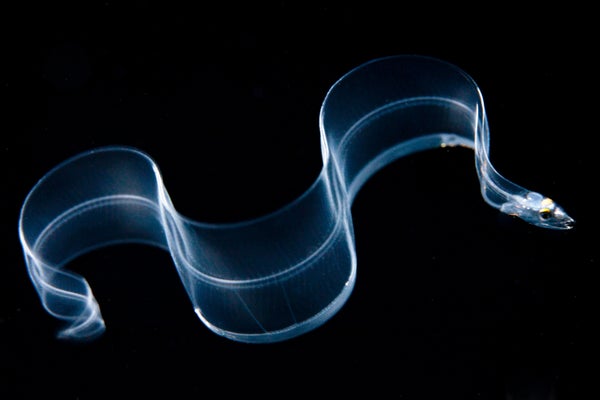
Every night in the open ocean zooplankton migrate toward the surface, away from their deepwater daytime habitat. They are followed by a large and diverse community of fish and invertebrates in what is called “diel vertical migration.” By scuba diving in the open ocean at night, so-called “blackwater divers” are some of the few people on Earth who get to see these weird and wonderful animals up close. “Blackwater diving really speaks to scuba divers that have seen most of what the reefs and wrecks have to offer and want to experience something completely different—a drifting, night dive miles away from shore in an environment where you will never see the bottom,” says Hawaii-based ecologist and underwater photographer Jeff Milisen. “What makes this dive so special is that it is completely unpredictable. With such a variety of animals inhabiting the epipelagic [uppermost] zone, even seasoned blackwater dive leaders frequently see animals and behaviors they have never experienced before. The list of possible encounters is as deep as the ocean.”
This unusual type of scuba diving was started in Hawaii and is practiced in a handful of other locations including Japan, Norway and Russia. Based in Kona on the west coast of Hawaii’s Big Island, Milisen leads dives a few times each week. There, you can get into very deep water after a very short boat ride. “From out there, the city lights from the island seem pretty distant,” Milisen says. “The divers are usually pretty experienced, but even still, the imaginary night monsters running through their heads seem very real. It often takes a few moments for the first brave diver to gather the gumption to suit up and jump in.”
Although Milisen has encountered a variety of potentially dangerous sea creatures, from sharks to predatory squid that can grow up to three meters in length, he has never been injured. “Fortunately, just like with nearshore predators and normal scuba divers, big animals don’t want to take the chance of injury to eat something as strange as us,” he says.
On supporting science journalism
If you're enjoying this article, consider supporting our award-winning journalism by subscribing. By purchasing a subscription you are helping to ensure the future of impactful stories about the discoveries and ideas shaping our world today.
Still, he understands why the thought of it makes some people nervous. “The unknown is a scary thing,” Milisen says. “The general public assumed that Jacques Cousteau was destined to become a meal for some strange sea creature, mostly because he was doing something different that people understood very little about. I don't think the public would have guessed that he would eventually die of a heart attack at home at 87.”
Milisen encourages adventurous scuba divers to give blackwater diving a try, because you’ll get to see some amazing things. “The animals in blackwater seem mysterious because they are new to us as divers, and not a lot of people get to see them in their natural environment,” he says. “Most of the animals have been studied by somebody somewhere, but most specimens are dead and degrading in alcohol. The behaviors are often completely undocumented!”