
Rarely does a speaker at a conference have to abandon a talk because he's seasick. But I saw it happen in August on a Scientific American/Bright Horizons cruise around the U. K. and Ireland, as our ship hit rough seas. The nauseated narrator finished his talk a few days later in calmer waters. And for the porpoises of this ocean-going column, all you need to know is that he was not Robert Sapolsky. I mean purposes.
Sapolsky, a neurobiologist and primatologist at Stanford University, got through his talks with no lunch losses. One presentation dealt with the health effects of chronic stress. “This link between stress and cardiovascular disease is so solid,” he said, “that it accounts for the most famous personality profile in all of medicine.” Type A personality, that is. “And I would guess if you're using a cruise to sit and listen to Scientific American lectures, this applies to like 80 percent of us in this room.”
Sapolsky continued, “Type A was first described by a pair of cardiologists, [Meyer] Friedman and [Ray] Rosenman, in the 1950s ... time-pressured, hostile, poor self-esteem, joyless striving.” The docs announced that these traits actually raise your risk of heart disease.
On supporting science journalism
If you're enjoying this article, consider supporting our award-winning journalism by subscribing. By purchasing a subscription you are helping to ensure the future of impactful stories about the discoveries and ideas shaping our world today.
“[Other] cardiologists hated these guys. You're some 1950s cardiologist, all you think about is Ozzie and Harriet and heart valves ... and instead here's these guys saying, ‘No, you need to sit down your patients and talk to them.’ Who wants to talk to their patients?!” Indeed, the happiest doctors I have ever met are pathologists.
“It wasn't till the 1980s that there were enough data in for people to say type A is for real,” Sapolsky said. “It is a bigger risk factor for cardiovascular disease than if you smoke, than if you are overweight, than if you have elevated cholesterol levels.”
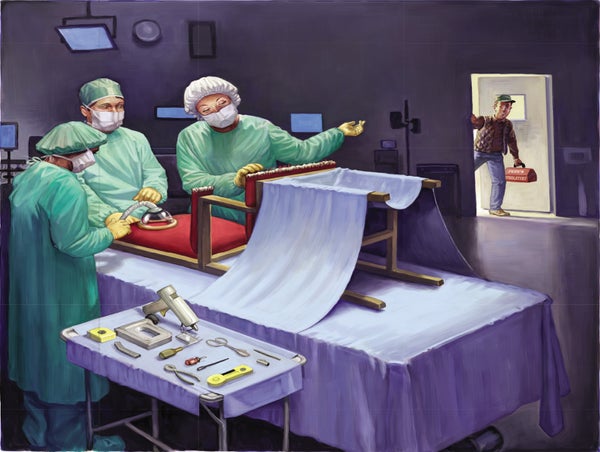
So how did Friedman and Rosenman identify this condition? “I actually got to hear this story from the horse's mouth himself, Meyer Friedman,” Sapolsky said. “He and his partner had this cardiology practice in San Francisco—everything was going great. They had this one problem, though. For some reason, they were wearing out chairs in the waiting room at an incredibly high rate.... Every month this upholsterer comes in, fixes a chair or two. One month the upholsterer is on vacation. A replacement upholsterer comes in, takes one look at the chairs and discovers type A personality. He says, ‘What is wrong with your patients? Nobody wears out chairs this way.’”
Sapolsky then showed a photograph of one of the chairs, which you can see in his book Why Zebras Don't Get Ulcers. “The front two inches of the seat cushion and the arm rests are totally shredded. The rest of the seat is perfectly fine. It's like every night there's dwarf beavers, and they're clawing at the chairs. What is this? This is what [a type A person] does when they're sitting in the waiting room of their cardiologist's office waiting to find out if there's bad news. Not just figuratively but literally sitting on the edge of their seat and clawing and squirming.
“So what's supposed to happen at this point if things worked right: Friedman grabs him and says, ‘Good God, man, what you've discovered!’ [And there are] midnight conferences between upholsterers and cardiologists. And [there are] teams of idealistic young upholsterers going across America and coming back with the news that, no, you don't find chairs like these in podiatrists' offices.”
What did the nonagenarian Friedman tell Sapolsky he actually did back in the 1950s? “He said, ‘I told my nurse ... get this man out of my face, he's wasting time, give him his damn check.’ He was too type A to listen to the guy. And it wasn't until five years later, they were collaborating with psychologists, out popped the type A profile, and they said, ‘Oh, my God, the upholsterer, he was right!’
“To this date, they have no idea who that man was. Now I'm willing to bet ... go to some bar in the Mission District in San Francisco, and there's gonna be this 110-year-old retired upholsterer. And get him started, and he's gonna go on and on about how he discovered type A personality.” And in so doing—you might want to take a seat yourself for this—changed the fabric of medicine.