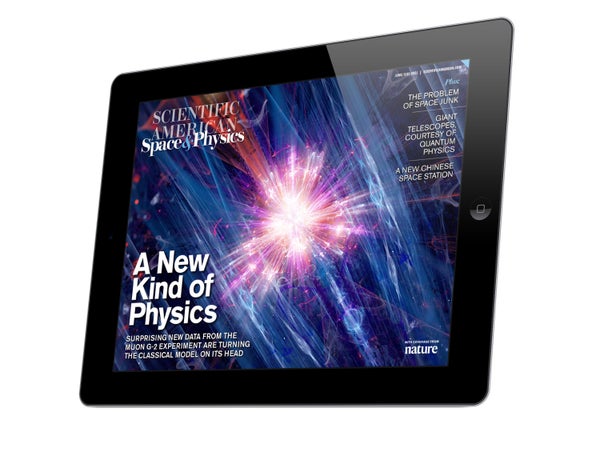
SA Space & Physics June/July 2021; Getty Images (cover background)
Join Our Community of Science Lovers!
On supporting science journalism
If you're enjoying this article, consider supporting our award-winning journalism by subscribing. By purchasing a subscription you are helping to ensure the future of impactful stories about the discoveries and ideas shaping our world today.
In April a team of physicists at Fermi National Laboratory in Batavia, Ill., announced anomalous behavior in the magnetic wiggle of the muon. The signal suggests that there may be other forces at work affecting the particle’s behavior besides those predicted by the Standard Model of physics (see “Long-Awaited Muon Measurement Boosts Evidence for New Physics”). But as physicist Sabine Hossenfelder outlines in her fascinating analysis of this finding, whether or not this discovery upends the classical rules depends on mind-bending statistics and higher-level calculations aided by computers to determine whether we have seen something significant or are merely observing a number- crunching fluke (see “Is the Standard Model of Physics Now Broken?”).
Elsewhere in the subatomic world, researchers are hoping that quantum hard drives might one day collect and store photon data from optical telescopes spread across the planet (see “Quantum Astronomy Could Create Telescopes Hundreds of Kilometers Wide”). Though invisible to human eyes, subatomic particles have been called the building blocks of matter and may be the key to understanding the nature of our universe.
Subscribe to Support Independent Journalism
Great science journalism requires human expertise, time, effort and creativity. And it costs money. That’s why I and the journalists here at Scientific American hope you’ll join our community.
When you subscribe, you are supporting staff and freelance journalists who are passionate about telling science stories that are true, important and compelling. Our editors and reporters are often experts in their fields, which means they understand the nuances of big discoveries and can untangle the breakthroughs from the hype. With a subscription, you are also supporting rigorous fact-checking to ensure the words we publish are precise and accurate. And you’re supporting original illustrations, graphics and photos that bring you closer to an advanced laboratory, an ice sheet in Antarctica or a space mission in orbit. You’re helping us craft other types of high-quality journalism as well: Our newsletters are carefully written, edited and curated by staffers you have or will come to know and love. Our Science Quickly podcast is based on original reporting, collaboration with editors and scientists and exacting production.
Subscriptions keep this engine running so we can continue to deliver thoughtful, rigorous and independent science journalism to you. In an era of viral misinformation, this work is crucial. If you value what we do, I hope you’ll consider joining us as a subscriber
Thank you,
Jeanna Bryner, Editor in Chief, Scientific American