
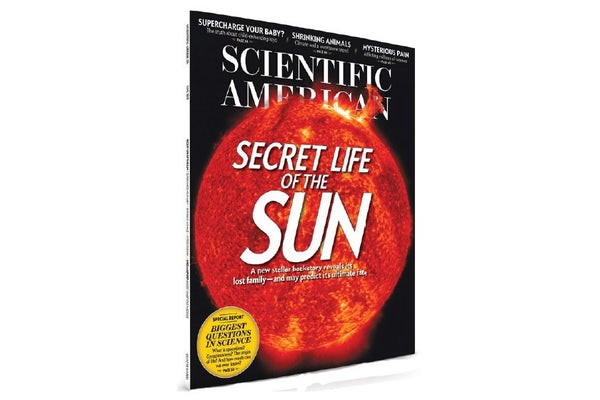
I have always been captivated by science's seemingly inexhaustible ability to produce new findings. And my favorite insights often require some mental time travel and also involve mysteries surrounding objects we think we know well. This month's cover story offers a bit of intellectual candy in providing both. In “The Secret Life of the Sun,” journalist Rebecca Boyle winds back the cosmic clock to our friendly neighborhood star's younger years. In that earlier era, we learn, our sun had a “mother,” “aunts” and “uncles”—even “siblings”—now residing elsewhere in the Milky Way. Our sun may have stolen a planet from a relative. And when it dies, perhaps it will help “birth” a future star.
In the realm of human births, what are parents to make of the numerous marketing messages on playthings and games offering to help their babies to learn and even to walk sooner? Journalist Erik Vance asks, “Can You Supercharge Your Baby?” Vance writes that although play is important for development, unfortunately little science backs up claims of supercharging tots with toys. We parents and caregivers remain the best educators for helping little ones learn how to navigate the world.
Whether it is the start of life for our sun or for our sons and daughters, science's ability to ask how things work drives how we are advancing discovery. Along these lines, I would like to point you to a special section on “The Biggest Questions in Science.” This report, part of an occasional series called Innovations In, which is being published by both Scientific American and our sister title, the journal Nature, examines some of the most fundamental puzzles of our existence.
On supporting science journalism
If you're enjoying this article, consider supporting our award-winning journalism by subscribing. By purchasing a subscription you are helping to ensure the future of impactful stories about the discoveries and ideas shaping our world today.
Contributing editor George Musser kicks off the section with his feature on “What Is Spacetime?” Other articles explore consciousness (by neuroscientist Christof Koch), nanoscience (journalist Neil Savage), dark matter (theoretical physicist Lisa Randall) and life's origins (biologist and Nobel laureate Jack Szostak). Rounding out the package, theoretical physicist Marcelo Gleiser asks the existential question, “How Much Can We Know?” This collaboration was developed independently by Scientific American and Nature editors, with the support of the Kavli Prize, which is celebrating the 10th year since the first Kavli Prizes honoring great minds who have looked at the world around them and wondered: Why? We may never know all the answers to our questions, but we are happy to join in cultivating humanity's eternal pursuit of knowledge.