
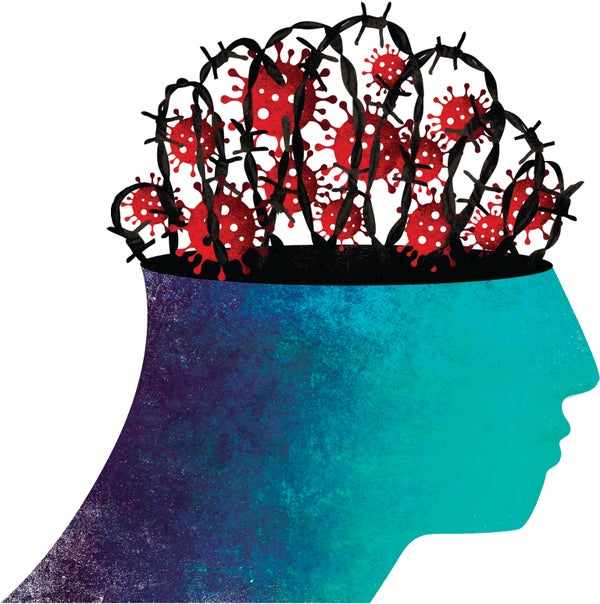
You didn't need a crystal ball to forecast that the COVID-19 pandemic would devastate mental health. Illness or fear of illness, social isolation, economic insecurity, disruption of routine and loss of loved ones are known risk factors for depression and anxiety. Now studies have confirmed the predictions. But psychologists say the findings also include surprises about the wide extent of mental distress; the way media consumption exacerbates it; and how badly it has affected young people.
For example, a report from the U.S. Centers for Disease Control and Prevention, published in August, found a tripling of anxiety symptoms and a quadrupling of depression among 5,470 adults surveyed compared with a 2019 sample. Similarly, two nationally representative surveys conducted in April, one by researchers at the Boston University School of Public Health and another at Johns Hopkins University, found that the prevalence of depressive symptoms (B.U.) and “serious psychological distress” (Hopkins) were triple the level measured in 2018. “These rates were higher than what we've seen after other large-scale traumas like September 11th, Hurricane Katrina and the Hong Kong unrest,” says Catherine Ettman, lead author of the B.U. study.
Some of the most affected groups in these studies were people who had preexisting mental health issues, low-income individuals, people of color, and those close to someone who suffered or died from COVID-19. In Ettman's study, however, the group in the U.S. with the single biggest rise in depression—up fivefold—was of Asian ethnicity. In an accompanying commentary, psychiatrist Ruth Shim suggested the upsurge could reflect the impact of racism and slurs related to the pandemic's origin in China.
On supporting science journalism
If you're enjoying this article, consider supporting our award-winning journalism by subscribing. By purchasing a subscription you are helping to ensure the future of impactful stories about the discoveries and ideas shaping our world today.
An unanticipated finding, across all three surveys, was the outsized toll on young adults. In the CDC survey, 62.9 percent of 18- to 24-year-olds reported an anxiety or depressive disorder, a quarter said they were using more drugs and alcohol to cope with pandemic-related stress, and a quarter said they had “seriously considered suicide” in the previous 30 days. Young adults were also the most affected age group in an unusual, real-time study that tracked the rapid rise in “acute distress” and depression at three points between mid-March and mid-April. “We expected the opposite because it was already clear that older individuals were at greater risk” from the virus, says senior author Roxane Cohen Silver, a psychologist at the University of California, Irvine.
Silver suspects that young people “may have had more disruption in life events: graduations, weddings, the senior year of college and of high school. All those transitions were disrupted, as well as school and social connections, which we know are very important for young people.”
Her study, which involved 6,500 people, does point to one major contributor to anxiety for people of all ages: increased engagement with media coverage of the outbreak. Especially problematic is exposure to conflicting information. Silver, who has studied the psychological fallout of events such as 9/11 and the 2013 Boston Marathon bombing, says that a fixation on media coverage is a known risk factor: “If people are engaged with a great deal of media, they are more likely to exhibit and report distress, but that distress seems to draw them further into the media. It's a cyclical pattern from which it is difficult to extricate oneself.”
Silver and others who investigate mass trauma have suggestions for keeping mental equilibrium in challenging times. Limiting media consumption and avoiding sensationalist reports is one. Maintaining social contacts—via Zoom, phone or other COVID-safe methods—is also vital, says psychologist James Pennebaker of the University of Texas at Austin. “Unlike any other disaster that I've studied, people are actively less close to friends and community,” says Pennebaker, who is examining the pandemic's mental health impact by analyzing posts on the social media platform Reddit.
Fewer hugs and less shared grieving may help explain why people do not seem to be adjusting to the new normal, Pennebaker says. “This is not 9/11 or an earthquake, where something big happens, and we all get back to normal pretty quickly.” His other tips are to maintain healthy sleep, exercise, food and drink habits. Keep a journal, too. Research shows that expressive writing helps people process difficult emotions and find meaning, he says: “If you're worrying about COVID too much, try writing about it.”