
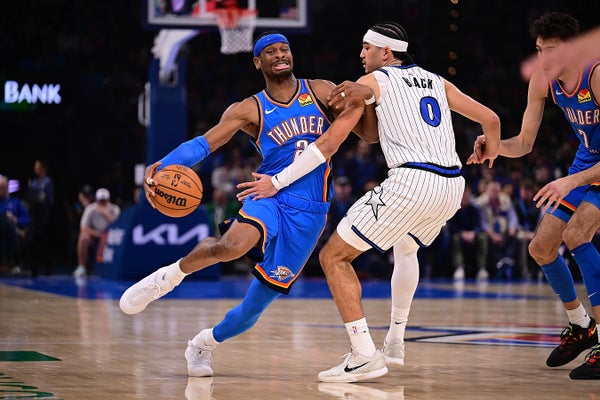
It’s officially squeak season.
The National Collegiate Athletic Association’s March Madness is right around the corner. The National Basketball Association (NBA) is fresh off its All-Star break, with the playoffs on the horizon. The playoffs for the women’s three-on-three league Unrivaled start this weekend—and Angel Reese will be back!
So turn on your TV and pump up the volume. Try tuning out the color commentary, the pulsating music and the “defense” chants, and what you’ll hear is basketball’s true soundtrack: a symphony of squeaks.
On supporting science journalism
If you're enjoying this article, consider supporting our award-winning journalism by subscribing. By purchasing a subscription you are helping to ensure the future of impactful stories about the discoveries and ideas shaping our world today.
Today, in a study published in the journal Nature, a team of scientists have made a “Wemby”-sized stride forward on the timeless scientific mystery of why basketball sneakers make those joyful noises.
“We were not expecting to find so much richness and depth, from a physics point of view, underneath the sole of a shoe,” says Adel Djellouli, a scientist at Harvard University and co-lead author of the study.
In a new study, scientists explore the physics that give rise to the familiar squeak of basketball shoes sliding on a hard surface.
Adel Djellouli/Harvard University
Most scientists who had considered the problem believed that shoe squeaks were a straightforward example of the common “stick-slip phenomenon.”
It’s easy to see stick-slip in action. Just plop a heavy book on a table and try to gently slide it across. Instead of a smooth slide, you’ll get a jerky, stop-and-start kind of motion.
Basketball squeaks, the theory went, were an example of the same phenomenon. When a player stopped on a dime, their shoe’s rubbery sole would slip slightly—many times per second in the same stop-and-start pattern—producing a squeak. This is how violins work and why a squeaky door hinge rings at a lower pitch when you open it slowly.
But with the power of high-speed cameras and acoustic analysis, Djellouli and his co-authors have shown that basketball shoes are special.
It’s all about the bumps. Those long, raised patterns of ridges that line the bottom of a sneaker are really the maestros of basketball’s soundscape. Watch the bottom of a shoe rubbing against the hardwood in slow motion, and you’ll see.
The sole’s ridges don’t lift and stick all at once. Rather only a tiny part of each ridge separates from the ground at any one time. That pocket of separation glides down the ridge until it reaches the end of the sole, at which point the air outside the shoe receives a little kick. Those separation waves ripple down the ridges thousands of times per second, kicking the air rhythmically. The rate of kicks is exactly the frequency of the squeak—the faster the kicks, the higher the pitch.
The team decided to demonstrate their new mastery of sneaker squeaks by playing a song. They chose Darth Vader's theme from Star Wars.
Adel Djellouli/Harvard University
That frequency depends on the shape of each ridge, which guides the waves down with a characteristic speed. “The idea of a waveguide for friction was not known,” says Gabriele Albertini, a structural engineer at the University of Nottingham in England and Djellouli’s co-lead author. To demonstrate their finding, the scientists reverse engineered rectangular blocks of synthetic sole with distinct pitches. They were even able to play Darth Vader’s theme from Star Wars on a piece of glass. “It took us three days to rehearse,” Djellouli says. “We could have just shown it in a graph, but where’s the fun in that?”
The sneaker study falls under the larger umbrella of “bimaterial friction,” the special physics of two different materials rubbing together. The phenomenon of two different faults slipping against each other to produce an earthquake, for instance, is much like a sneaker rubbing on hardwood. Rather than the entire fault stopping and starting, ripples of separation move along it similarly to what happens with the sneaker. The team believes its rubber setup could become an easy way to study earthquake physics in a lab.
“This is a more advanced and technically sophisticated analysis of a problem I dipped my toe into 20 years ago,” says Martyn Shorten, a stick-slip expert at BioMechanica, a consulting firm in Oregon. “I love it!”
So next time you see NBA player Shai Gilgeous-Alexander take someone’s ankles, remember that the spectacle’s squeaky score is something to behold as well. And when you cop your favorite player’s new signature shoe, you’re buying a finely tuned musical instrument that simulates an earthquake with every step. Who knows—maybe we’re just a few years off from “signature squeaks!”