
In 1999 the late Douglas Adams penned a column for London's Sunday Times on gripes about the nascent Internet. “Another problem with the net is that it's still ‘technology’, and ‘technology’, as the computer scientist Bran Ferren memorably defined it, is ‘stuff that doesn't work yet,’” he wrote. “We no longer think of chairs as technology, we just think of them as chairs.”
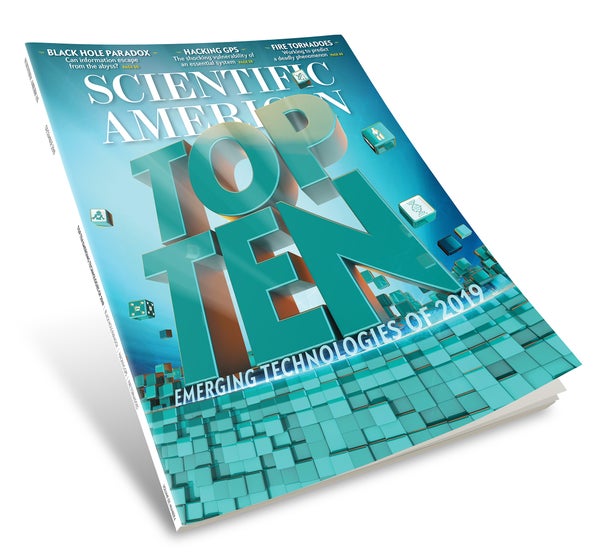
Our cover story, entitled “Top 10 Emerging Technologies of 2019,” showcases diverse inventions that our editors hope one day will become as common as chairs. Like the Internet, these viable technologies could yield disruptive change with major social and economic benefits. The annual list, now in its third year in print, is produced in collaboration with the World Economic Forum. A Steering Group, co-chaired by Scientific American editor emerita Mariette DiChristina and IBM chief innovation officer emeritus Bernard S. Meyerson, reviews dozens of nominations drawn from the magazine's board of editors and the forum's network of experts before making final selections.
One technology that isn't on the list but that has emerged in full force is the Event Horizon Telescope (EHT), an array of radio telescopes that captured the world's first picture of a black hole—a fiery ring of starlight surrounding a dark center. Astronomers now believe these mysterious structures are common throughout the universe, but as quantum physicist Steven B. Giddings explains in “Escape from a Black Hole,” “their very existence threatens the present foundations of physics.” New characterizations of black holes might resolve that conundrum, and the EHT, along with gravitational-wave detectors (another recent feat of technology), could finally help scientists test their predictions.
On supporting science journalism
If you're enjoying this article, consider supporting our award-winning journalism by subscribing. By purchasing a subscription you are helping to ensure the future of impactful stories about the discoveries and ideas shaping our world today.
Alas, some game-changing technologies are so commonplace that we take them for granted, often at our peril. Take GPS, the satellite-based Global Positioning System. People use it to find their way to and from locations every day, but it is also essential to the 16 “critical infrastructure sectors” in the U.S., including energy, health care and finance. And the system is under attack. Hackers can jam or spoof GPS with shocking ease, journalist Paul Tullis warns in “GPS Down.” Moreover, whereas many countries have a ground-based backup system that is difficult to tamper with, the U.S. has never built one—something to think about if you happen to be reading this at an American airport.
There are many other reminders in the issue about the importance of technology to nearly every aspect of modern life, from lab equipment that helps emergency responders understand when and where dangerous wildfires erupt (“Fire Tornadoes,” by Jason M. Forthofer) to debates about whether or not artificial-intelligence systems could ever be truly conscious (“Proust among the Machines,” by Christof Koch).
I am also reminded, as Scientific American heads into its 175th year of publication, how technology underlies the history of this magazine. Our founding editors dubbed us “the advocate of industry and enterprise, and journal of mechanical and other improvements.” So here's to all those Promethean scientists who, over the decades, have harnessed the elements of nature in pursuit of a better world and let us tell such wonderful stories along the way.