
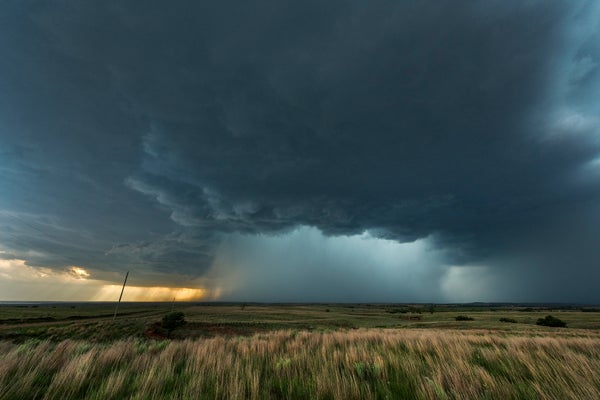
A large swath of the U.S., spanning the Upper Mississippi Valley, the Midwest and some of the Atlantic Coast is at risk of severe weather. “Scattered to numerous” thunderstorms, golf-ball-sized hail, high winds and “a few strong tornadoes” could hit some parts of the country in the next few days, according to the National Oceanic and Atmospheric Administration.
“It’s a really active pattern across the country right now with respect to thunderstorms, and it’s expected to remain pretty active over the next several days,” says Bob Oravec, a meteorologist at NOAA’s Weather Prediction Center.

Forecasted severe weather in the US, including thunderstorms, for Wednesday through Saturday, June 14, as of Wednesday, June 10.
On supporting science journalism
If you're enjoying this article, consider supporting our award-winning journalism by subscribing. By purchasing a subscription you are helping to ensure the future of impactful stories about the discoveries and ideas shaping our world today.
Some of the effects are already here. “It’s going to be an afternoon and evening of widespread thunderstorm development,” particularly in the Midwest, even stretching down into parts of Oklahoma, says Bill Bunting, deputy director of NOAA’s Storm Prediction Center. “The strongest storms will certainly be capable of producing widespread damaging winds [and] large hail, and we do have the concern for tornadoes that will continue through this evening.”
The turbulent conditions are caused by a cold front traveling eastward across the northern part of the country, Oravec explains—as the cold front collides with warm, humid air coming off the Gulf of Mexico, it can produce thunderstorms. “Anytime you get warm, humid air along a frontal boundary, you often can see thunderstorm activity,” Oravec says. “This is what’s going to occur over the next several days as this front moves southeastward.”
“We have an air mass that is very warm, very moist, very sticky,” Bunting adds. That can be typical for this time of year, but it can also lead to “a more unstable atmosphere”—helping ramp up thunderstorms’ intensity, he says.
At least one more cold front is expected over the weekend—so the risk of extreme weather may continue, including in other areas of the country such as portions of the Central and Southern Plains, Oravec says.
“Even though it moves to a different location every day, the overall story is: active thunderstorms along and ahead of the cold front. And those active thunderstorms will have the potential to produce severe weather, flash flooding and dangerous lightning,” he says.
For people in affected areas, being aware is the best way to prepare, Oravec says. Bunting recommends thinking about a “severe weather plan” before storms develop and signing up for weather alerts in your area to keep up with any possible threats, including tornadoes.
“We know there’s potential over a larger area for these conditions. But when the details are issued for the warnings, they’re typically over smaller areas,” Oravec adds.