The Universe in 100 Colors Provides a Stunning Tour through Science

A science photo book probes the colors we can see—and even “forbidden” colors we can’t

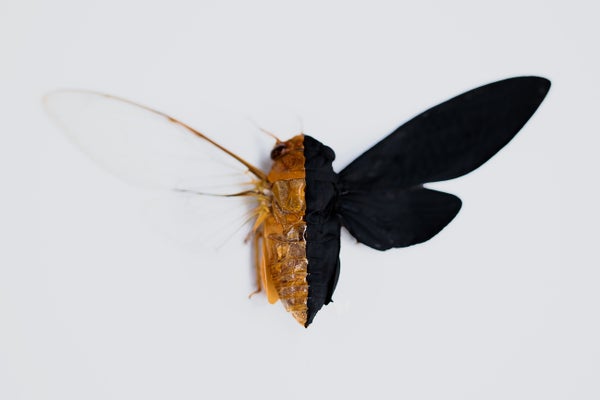
A simulation of Van­ta­black on a cicada, with one side painted very deeply black

A simulation of Van­ta­black on half of a cicada.

Tyler Thrasher; From The Universe in 100 Colors, by Tyler Thrasher and Terry Mudge (Sasquatch Books, 2024)

Join Our Community of Science Lovers!

Humanity is lucky to reside on a planet circling a star with plentiful radiation, illuminating the world around us in reflected wavelengths of light. These wavelengths—a portion of which we experience as color—have long warned us of danger and enticed us to closely inspect the objects we encounter.

In a new photo book, The Universe in 100 Colors, science enthusiasts Tyler Thrasher and Terry Mudge take readers on a tour of color across scientific disciplines—from things most people will never see in day-­to-­day life (such as the black color of the brain’s dopamine precursors, a lack of which can lead to Parkinson’s disease) to ubiquitous backdrops (for instance, the green porcelain that gives chalkboards their color). Some are fanciful: the drab color routinely used to paint rental apartments is called “landlord white,” for example. Still others are profound—such as the peachy orange that would have been the universe’s first visible color if humans had been around to see it.

“It’s a story of light and all the creative paths that it can take in its journey to your eyeball,” says Mudge, who curates a science subscription box called Matter. And then there are the paths it can’t take: one section of the book details views our visual systems can’t naturally perceive, including the “forbidden” colors you’d get by processing red and green wavelengths simultaneously.


On supporting science journalism

If you're enjoying this article, consider supporting our award-winning journalism by subscribing. By purchasing a subscription you are helping to ensure the future of impactful stories about the discoveries and ideas shaping our world today.


Above you can see a simulation of Van­ta­black, a paint containing tiny carbon nano­tubes that squirrel away 99.6 percent of the light that touches them, removing details of shape and shadow and rendering 3D objects into indistinct blobs. The paint was invented by a materials scientist but exclusively licensed to a particular artist, so it’s “forbidden” in a much more prosaic way—one reason the book’s authors had to digitally edit the cicada pictured here to demonstrate the effect themselves.

In art and science, “the goal of both is to make observations about the world around us and communicate something,” says Thrasher, who describes himself as a “mad scientist artist.” And “when you combine the two, when you start to bring creative ex­­­pression to science, I think you get closer to what a lot of people call alchemy.”

Sarah Lewin Frasier is a senior editor at Scientific American. She plans, assigns and edits the Advances section of the monthly magazine, as well as editing online news, and she launched Scientific American’s Games section in 2024. Before joining Scientific American in 2019, she chronicled humanity’s journey to the stars as associate editor at Space.com. (And even earlier, she was a print intern at Scientific American.) Frasier holds an A.B. in mathematics from Brown University and an M.A. in journalism from New York University’s Science, Health and Environmental Reporting Program. She enjoys musical theater and mathematical paper craft.

More by Sarah Lewin Frasier
Scientific American Magazine Vol 331 Issue 5This article was published with the title “Multihued Universe” in Scientific American Magazine Vol. 331 No. 5 (), p. 14
doi:10.1038/scientificamerican122024-3NjgNGp8sd8rPoLrwlLpxN

It’s Time to Stand Up for Science

If you enjoyed this article, I’d like to ask for your support. Scientific American has served as an advocate for science and industry for 180 years, and right now may be the most critical moment in that two-century history.

I’ve been a Scientific American subscriber since I was 12 years old, and it helped shape the way I look at the world. SciAm always educates and delights me, and inspires a sense of awe for our vast, beautiful universe. I hope it does that for you, too.

If you subscribe to Scientific American, you help ensure that our coverage is centered on meaningful research and discovery; that we have the resources to report on the decisions that threaten labs across the U.S.; and that we support both budding and working scientists at a time when the value of science itself too often goes unrecognized.

In return, you get essential news, captivating podcasts, brilliant infographics, can't-miss newsletters, must-watch videos, challenging games, and the science world's best writing and reporting. You can even gift someone a subscription.

There has never been a more important time for us to stand up and show why science matters. I hope you’ll support us in that mission.

Thank you,

David M. Ewalt, Editor in Chief, Scientific American

Subscribe