
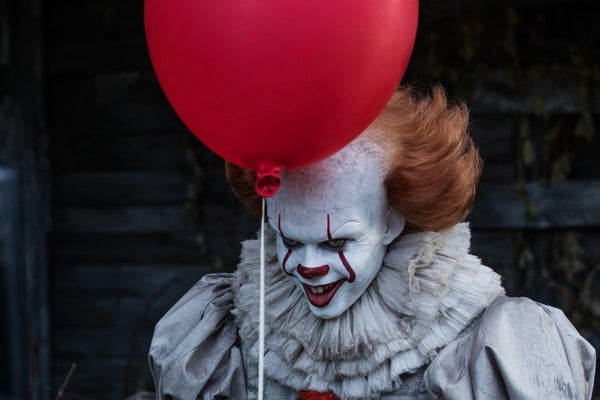
Are you scared of clowns? You are not alone. Coulrophobia, or the fear of clowns, is a widely acknowledged phenomenon. Studies indicate this fear is present among both adults and children in many different cultures. Yet it is not well understood due to a lack of focused research.
While numerous possible explanations of the phobia had been put forward in academic literature, no studies had specifically investigated its origins. So we set out to discover the reasons people are frightened by clowns, and to understand the psychology behind this. We also wanted to explore how common the fear of clowns is in adults and to look at the severity of the fear in those who reported it.
To do this, we devised a psychometric questionnaire to assess the prevalence and severity of coulrophobia. The Fear of Clowns Questionnaire was completed by an international sample of 987 people aged between 18 and 77.
On supporting science journalism
If you're enjoying this article, consider supporting our award-winning journalism by subscribing. By purchasing a subscription you are helping to ensure the future of impactful stories about the discoveries and ideas shaping our world today.
More than half the respondents (53.5%) said they were scared of clowns at least to some degree, with 5% saying they were “extremely afraid” of them. Interestingly, this percentage reporting an extreme fear of clowns is slightly higher than those reported for many other phobias, such as animals (3.8%), blood/injection/injuries (3.0%), heights (2.8%), still water or weather events (2.3%), closed spaces (2.2%), and flying (1.3%).
We also found that women are more afraid of clowns than men. The reason for this difference is not clear, but it echoes research findings on other phobias such as the fear of snakes and spiders. We also discovered coulrophobia decreases with age, which again matches up with research into other fears.
Origins of this fear
Our next step was to explore the origins of people’s fear of clowns. A follow-up questionnaire was given to the 53.5% who had reported at least some degree of clown fear. This new set of questions related to eight plausible explanations for the origins of this fear, as follows:
An eerie or unsettling feeling due to clowns’ makeup making them look not-quite-human. A similar response is sometimes seen with dolls or mannequins.
Clowns’ exaggerated facial features convey a direct sense of threat.
Clown makeup hides emotional signals and creates uncertainty.
The colour of clown makeup reminds us of death, infection or blood injury, and evokes disgust or avoidance.
Clowns’ unpredictable behaviour makes us uncomfortable.
Fear of clowns has been learned from family members.
Negative portrayals of clowns in popular culture.
A frightening experience with a clown.
Intriguingly, we found the final explanation, of having had a scary personal experience with a clown, had the lowest level of agreement. This indicates that life experience alone is not a sufficient explanation for why people are afraid of them.
In contrast, negative portrayals of clowns in popular culture was a much stronger contributing factor towards coulrophobia. This is understandable since some of the most prominent clowns in books and films are designed to be scary – such as Pennywise, the creepy clown from Stephen King’s 1986 novel It. (This character most recently featured in two films in 2017 and 2019, with Bill Skarsgård in the starring role.)
However, some people are afraid of Ronald McDonald, the fast food chain mascot, and he is not meant to scare you. This suggests there might be something more fundamental about the way clowns look that unsettles people.
In fact the strongest factor we identified was hidden emotional signals, suggesting that for many people, a fear of clowns stems from not being able to see their facial expressions due to their make-up. We cannot see their “true” faces and therefore cannot understand their emotional intent. So, for example, we don’t know whether they have a frown or a furrowed brow, which would indicate anger. Not being able to detect what a clown is thinking or what they might do next makes some of us on edge when we are around them.
Read more: Calling politicians 'clowns' is a disservice to clowns – yes, really
This research has provided some new insights into why people are afraid of clowns – yet more questions remain. For instance, if makeup which masks emotions causes fear, do people who have their faces painted as animals also create the same kind of effect? Or is there something more particular about the makeup of clowns that drives this fear? This is now the focus of our continued research.

The following essay is reprinted with permission from The Conversation, an online publication covering the latest research.