
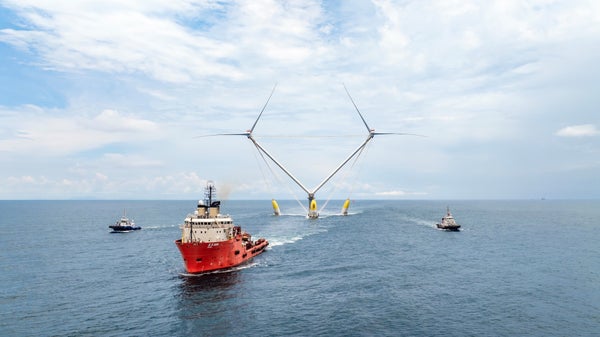
The world’s largest wind turbine—currently being tested off the coast of China—has blades that are more than twice as long as a Boeing 777’s wingspan. It can generate 26 megawatts (MW) of energy, more than double the global average for individual turbines. But its record is about to be smashed to smithereens: another offshore wind turbine that is twice as powerful has been announced by Ming Yang Smart Energy, a company based in southern China.
With a capacity of 50 MW, this supersized structure is designed to float on the ocean’s surface and can withstand typhoons, according to the company, which plans to start making the turbine later this year and to deploy it next year.
Though Western manufacturers such as Siemens Gamesa are also pushing for bigger and bigger turbines, the trend has been particularly dominant in China after the government stopped subsidizing offshore wind farms in 2022, forcing developers to find ways to save money. Using bigger turbines means that fewer of them will be needed to generate the same amount of power, says Zhu Ronghua, director of Yangjiang Offshore Wind Energy Laboratory, a research institute supported by the provincial government of Guangdong in China. “You can save on transport, construction and installation fees, which account for 70 to 80 percent of the cost of building an offshore wind farm,” Zhu says.
On supporting science journalism
If you're enjoying this article, consider supporting our award-winning journalism by subscribing. By purchasing a subscription you are helping to ensure the future of impactful stories about the discoveries and ideas shaping our world today.
Twin-Headed Turbines
In general, a turbine with a larger capacity is also physically bigger. This is because you need longer blades to catch more wind and generate more electricity per sweep. The current record-holding turbine, made by Dongfang Electric, is so enormous that its tower is as tall as a 63-story skyscraper.
But Ming Yang is taking a different approach: Its megamachine will have not one but two sets of engines and blades, each capable of generating 25 MW of energy. They are supported by a Y-shaped tower on a single platform. Each of its blades is 145 meters long, roughly three times the height of the Statue of Liberty. The design builds on that of the world’s first twin-headed turbine, a 16-MW version that is currently operating in the South China Sea, and combines the output of two turbines in one. “If successful [at this scale], this model can be a game changer in the floating wind industry,” says Umang Mehrotra, an offshore wind analyst at the Norwegian research firm Rystad Energy.

Eve Lu; Sources: Ming Yang Smart Energy presentation at China Wind Power 2025, Beijing, October 2025 (twin-headed 50-MW turbine); Dongfang Electric Wind Power (26-MW turbine); National Park Service (Statue of Liberty); Golden Gate Bridge, Highway and Transportation District (Golden Gate Bridge); Empire State Building (Empire State Building)
Han Yujia, a researcher of renewable energy at the California-based nonprofit Global Energy Monitor, is most impressed that Ming Yang intends to increase a turbine’s capacity by more than 20 MW in one go, far outpacing the industry’s average rate of increase of 2–3 MW each year.
Ming Yang says that the 50 MW turbine will have a “strong ability” to counter typhoons but hasn’t yet provided more details on how it will do so. The 16-MW model, which is supposed to serve as a prototype, has survived multiple typhoons over the past year, including more than 150-kilometer-per-hour winds from Typhoon Ragasa, says Wang Chao, chief designer for this line of models, known as OceanX. Some of its resilience is because of the fact that it is tethered to the ocean floor at a single point, so it can rotate 360 degrees “like a weather vane” and stay balanced during high winds, Wang says. The feature also means that the turbine can be installed in deeper waters, farther away from the shore, where wind is stronger and more consistent.
But the new model will be significantly bigger, so there could be “a lot of risks,” Mehrotra says. And there are potential technical difficulties in ensuring that the two rotors generate power smoothly because they are so close together on a single platform compared with the general spacing specifications of side-by-side turbines, he says. A representative of Ming Yang did not respond to requests for comment from Scientific American.