
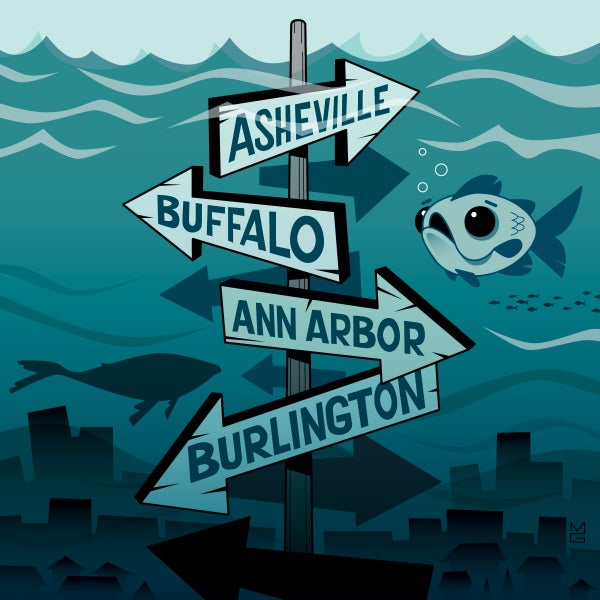
In September 2024 Hurricane Helene flooded the mountain town of Asheville, N.C., which had once been called a climate haven, a place less prone to the toll of climate change. In March 2025 fires coursed throughout the state. Fires also claimed Myrtle Beach, on the South Carolina coast. From sea to sky, the Carolinas have been grappling with disaster.
All the while, people make lists of places in the U.S. that are supposedly more resistant to climate change. They lie farther north, presumed to be better insulated from global warming, or near rivers or lakes that would ballast drought. Buffalo, N.Y., Ann Arbor, Mich., Burlington, Vt. Not to mention Asheville.
But what befell Asheville illustrates how no place in the U.S.—in the world, really—is safe from the ravages of the climate crisis. There are no climate havens. Places touted as less prone to heat, such as Asheville, are subject to floods and more intense snowfall. Those close to water face rising sea levels or floods. Population growth would strain water supplies, eventually spoiling these places as the rest of the country continues to endure more intense wildfires, more destructive hurricanes and tornadoes, prolonged droughts, and intensifying heat waves. There is nowhere to run to get away from climate change.
On supporting science journalism
If you're enjoying this article, consider supporting our award-winning journalism by subscribing. By purchasing a subscription you are helping to ensure the future of impactful stories about the discoveries and ideas shaping our world today.
Earth’s temperature is increasing, polar ice is melting, and the northern U.S. is seeing summer heat like never before. Winter freezes are crippling the power grid in Texas and other southern regions. Migration is not a quick fix for the climate crisis, and it certainly isn’t the most equitable. We must recognize that in addition to curbing our fossil-fuel use, adequately fortifying and restructuring the spaces we already have will give us and the next generations the best possible chance of survival.
How every level of government chooses to respond to this crisis will matter.
First and foremost, we need governance at all levels to accept not only that climate change is real but that it is something we must both adapt to and mitigate. These two ideas are not mutually exclusive—choosing adaptation, or changing our local environments to make them more resilient to climate change, doesn’t mean we no longer try to slow that change.
Perhaps on top of its favorable location and weather, Asheville was considered a climate haven because its local government has accepted the reality of climate change. Before the floods came, the city had approved its Municipal Climate Action Plan, setting goals for renewable energy, more sustainable infrastructure and reduced waste production in the city. The plan states that one of its goals is an increase in renewable energy generation, including the use of solar panels to power city-owned properties and adherence to sustainable practices for new construction and retrofits. But with the loss of tree cover and the demands of a growing population making Asheville more vulnerable to landslides, the city will have to continue to adjust—as will the state, which has its own climate resiliency plan.
But will North Carolina be able to use disaster relief to push through a sustainable recovery under threat from the politicization of climate change? The state’s resiliency office is underfunded even though the new governor, Josh Stein, campaigned in part on building a state better able to withstand the effects of climate change. It’s not immediately clear how his slew of disaster-related executive orders about temporary housing and rebuilding roads and bridges will factor into adaptation efforts.
What is clear is that the idea that people will be able to up and move to some cities or states that seem more able to withstand our climate crisis is profoundly unjust. The median home price in Washtenaw County, Michigan, where Ann Arbor is located, is about $380,000. That makes it the second-most expensive county in the state. Other Michigan counties are significantly cheaper, but few are prepared, or even preparing, for permanent population increases. Winter is getting shorter along the Great Lakes, and not only is flooding becoming more of an issue, but the weather is getting hotter. Even housing prices in Buffalo are increasing.
The bottom line is that historically mild weather, historically agreeable climates and historically responsive governments have made some places in the U.S. seemingly more resistant to the effects of climate change. But the crisis knows no boundaries—Canadian wildfires blew smoke into New York City last summer and blanketed Buffalo the year before. Even adaptation won’t completely solve the problem.
In the end, how every level of government chooses to respond to this crisis will matter. Individual cities can’t manage this problem alone, and neither can states. How will cities such as Austin, Tex., make meaningful adaptations in one of the U.S. states most susceptible to global warming if its governor and legislature largely downplay climate concerns and actively thwart efforts to reduce fossil-fuel use? Texas’s water supply is in dire straits, and far too many people there and in places such as Arizona will be left behind in this great migration north.
And how will we fare as a nation under an administration that denies climate change is real? One that is actively rolling back environmental protections, throwing out environmental justice cases, and promoting the production of more and more fossil fuels?
The idea that any one place in any nation is more resistant or more resilient to forces that are global in nature is clever marketing and nothing else. The message might make people feel better by letting them believe they can just escape the climate crisis by moving to a different city, but this is a bill of goods. Our entire planet is in the throes of warming. Rather than trying to outrun it, we must demand leadership that will help fund our efforts to adapt, look to state and local leaders to make those adaptation plans reality, and continue to seek ways to change the very things that started this climate-haven conversation in the first place—burning fossil fuels and abusing our forests, farmlands and good fortune.