
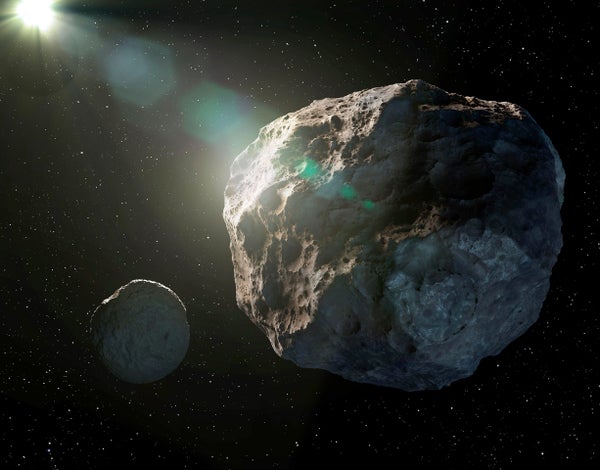
An ultraprecise satellite tasked with mapping more than a billion stars across the galaxy has spotted something fascinating closer to home: 352 asteroids in the solar system that likely have their own orbiting moons. These systems, known as “binary asteroids,” are challenging to pinpoint because of their distance from Earth and comparatively small size.
Scientists brought these systems into focus by looking at data on the objects’ motion from the European Space Agency’s (ESA’s) Gaia spacecraft, which floats about 930,000 miles (1.5 million kilometers) from Earth. This is the first set of binary asteroid candidates identified using only the positions and movements of celestial bodies, says Luana Liberato, an astrophysicist at the Côte d'Azur Observatory in France and lead author of the study, published today in Astronomy & Astrophysics.
The Gaia spacecraft is made up of two optical telescopes that reflect light toward a specialized detector, allowing it to record the precise motions of numerous celestial objects as it hurtles around our solar system. For this study, the team analyzed measurements from the Gaia mission’s third data release, searching through more than 150,000 asteroids identified by the spacecraft and looking for signs of “wobble”—a change in an object’s expected position that is likely caused by the gravitational pull of another object that orbits it.
On supporting science journalism
If you're enjoying this article, consider supporting our award-winning journalism by subscribing. By purchasing a subscription you are helping to ensure the future of impactful stories about the discoveries and ideas shaping our world today.

The orbits of 156 823 asteroids identified as part of Gaia Data Release 3. The wider blue and yellow circles in the frame show planetary orbits, while the myriad colorful inner swirls are asteroids. All of the central region lies within the orbit of Jupiter (blue circle).
ESA/Gaia/DPAC (CC BY-SA 3.0 IGO)
“Most of the binary asteroids we know about have been discovered from the ground,” says Jay McMahon, an aerospace engineer at the University of Colorado Boulder, who was not involved in the study. “We have to get lucky that they fly close enough to the Earth.”
Gaia is “a really huge, precise telescope,” McMahon continues. “It’s been able to find a lot and characterize better than we’ve done historically on the ground.”
Asteroids are the rocky remains of our solar system’s early days. Although further analysis is needed to determine if these candidate systems are indeed what they appear, newfound binary pairs can help reveal more about asteroids’ structure and their movements, which could potentially offer unique insights into the formation of the solar system.
“It’s very hard to measure the masses of asteroids,” says Shantanu Naidu, a radar astronomer at NASA’s Jet Propulsion Laboratory, who researches binary asteroids and was not involved in the study. “In a binary system, you’re able to measure the period at which the moon is orbiting, and in those cases, you can get a direct measurement of the mass of the system.”
Knowing this mass lets researchers calculate an asteroid’s volume and density, which then sheds light on its composition and porosity. “Once you know such properties, you can put the pieces together and start getting the bigger picture of how these asteroids evolve,” Naidu says.
The ESA and NASA have other missions aimed at improving our understanding of binary asteroids as well. The recent Double Asteroid Redirection Test (DART) mission, for example, sent a spacecraft crashing into an asteroid’s moon to investigate potential ways to defend against planet-threatening asteroids. ESA’s Hera mission, set to launch in October, would evaluate the aftermath of the DART mission’s collision.
Knowledge of binary asteroids’ makeup and evolution can potentially divulge details on an even broader scale. “Asteroids are the building blocks of the planets, and they carry the history of the formation of the solar system,” Liberato says. “Studying binary asteroids allows us to understand more about the physical and chemical processes that happen during the formation and evolution of planetary bodies, such as collision dynamics, gravitational interaction, exchange of material, and much more.”