
Defying progress
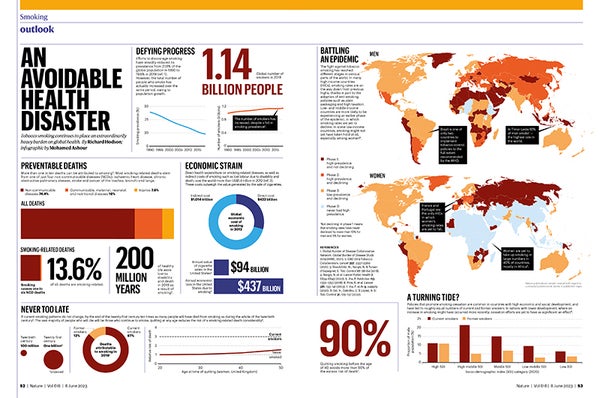
Efforts to discourage smoking have steadily reduced its prevalence from 27.8% of the global population in 1990 to 19.6% in 2019. However, the total number of people who smoke has actually increased over the same period, owing to population growth. In 2019, there were 1.14 billion smokers worldwide.

Credit: Nature; Infographic: Mohamed Ashour. Source: Ref. 1
On supporting science journalism
If you're enjoying this article, consider supporting our award-winning journalism by subscribing. By purchasing a subscription you are helping to ensure the future of impactful stories about the discoveries and ideas shaping our world today.
Preventable deaths
More than one in ten deaths can be attributed to smoking. Most smoking-related deaths stem from one of just four non-communicable diseases (NCDs): ischaemic heart disease, chronic obstructive pulmonary disease, stroke and cancer of the trachea, bronchi and lungs. Smoking causes one in six deaths from non-communicable diseases. 200 million years of healthy life were lost to disability and death in 2019 as a result of smoking.

Credit: Nature; Infographic: Mohamed Ashour. Source: Ref. 2
Economic strain
Direct health expenditure on smoking-related diseases, as well as indirect costs of smoking such as lost labour due to disability and death, cost the world more than US$1.4 trillion in 2012. These costs outweigh the value generated by the sale of cigarettes.

Never too late
If current smoking patterns do not change, by the end of the twenty-first century ten times as many people will have died from smoking as during the whole of the twentieth century.

Credit: Nature; Infographic: Mohamed Ashour. Source: Ref. 5
The vast majority of people who will die will be those who continue to smoke; quitting at any age reduces the risk of a smoking-related death considerably. Quitting smoking before the age of 40 avoids more than 90% of the excess risk of death.

Credit: Nature; Infographic: Mohamed Ashour. Source: Ref. 6
Battling an epidemic
The fight against tobacco smoking has reached different stages in various parts of the world. In many high-income countries (HICs), smoking rates are on the way down from previous highs, thanks in part to the adoption of anti-smoking policies such as plain packaging and high taxation.

Credit: Nature; Infographic: Mohamed Ashour. Source: Ref. 8
Low- and middle-income countries are more likely to be experiencing an earlier phase of the epidemic, in which smoking rates are yet to decline. In some low-income countries, smoking might not yet have taken hold at all, especially among women.

Credit: Nature; Infographic: Mohamed Ashour. Source: Ref. 8
‘Not declining’ in phase 1 means that smoking rates have never declined by more than 10% for men and 5% for women.
A turning tide?
Policies that promote smoking cessation are common in countries with high economic and social development, and have led to roughly equal numbers of current and former smokers. In nations with lower development, where an increase in smoking might have occurred more recently, cessation efforts are yet to have as significant an effect.

Credit: Nature; Infographic: Mohamed Ashour. Source: Ref. 8
This article is part of Nature Outlook: Smoking, an editorially independent supplement produced with the financial support of third parties. About this content.