
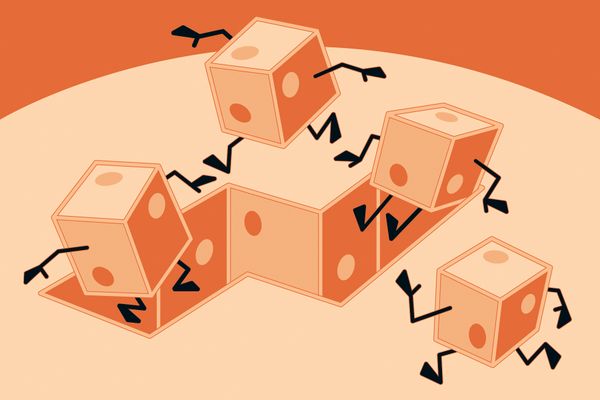
Cells do not have brains. Yet somehow, as an organism grows, cells know where to go and what to be without top-down direction. And acting together, cells are collectively intelligent, ultimately building complex final forms—whether that be a flower, a whale, or even you. Mimicking this ability in machines could one day lead to self-healing circuits and computers that can assess and repair damage as it happens, and new research published in Nature Communications shows how smart “bricks” could move us closer to that goal.
A future in which machines build themselves is “all about local self-organization where you don’t have one failure point,” says Sebastian Risi, the paper’s senior author and a computer scientist at IT University of Copenhagen and Sakana AI.
First, the researchers created simulations of cubes, each with an independently operated neural network, assembled into nearly 500 3D shapes across seven object categories—boats, cars, chairs, guitars, houses, planes and tables—and tested whether the cubes could identify their category. Each virtual cube contained a list of numbers called a vector with its memory and a guess about object category, both of which can evolve over time. Each cube’s neural network told it how to update its vector based on its neighbors’. Together, the cubes formed what’s called a neural cellular automaton. (The classic example of cellular automata is John Conway’s Game of Life, devised in 1970, in which pixels flash on and off based on how many neighbors they have.)
On supporting science journalism
If you're enjoying this article, consider supporting our award-winning journalism by subscribing. By purchasing a subscription you are helping to ensure the future of impactful stories about the discoveries and ideas shaping our world today.
The simulated cubes passed messages and altered their vectors based on, first, their own immediate environment, such as whether they were on an edge, then their neighbors’, and so on. After the neural network was trained, cubes named their object class with 85 to 100 percent accuracy—houses proved trickiest. “It’s remarkable that the bricks can infer the global shape of the collective using only local information,” says Sabine Hauert, who studies swarm robotics at the University of Bristol and was not involved in the work.
The virtual cubes could often identify their shape even if 15 percent of them had been removed, as well as decide which cubes were missing and regenerate neighbors. And the team found that systems of more than 18,000 cubes could still guess the objects they were in.
Finally, the researchers tested their system using real blocks, each a few centimeters across, with circuitry inside that ran computations locally. When up to 197 were connected into a shape, they accurately identified what object they were 100 percent of the time.
Risi says a near-term application is in edutainment: build a dinosaur that then roars, or use construction bricks that tell you where to place the next one. Over the long term, the researchers envision modular robots that assemble themselves, no instruction manual required.