
Aza Allsop
Yale School of Medicine
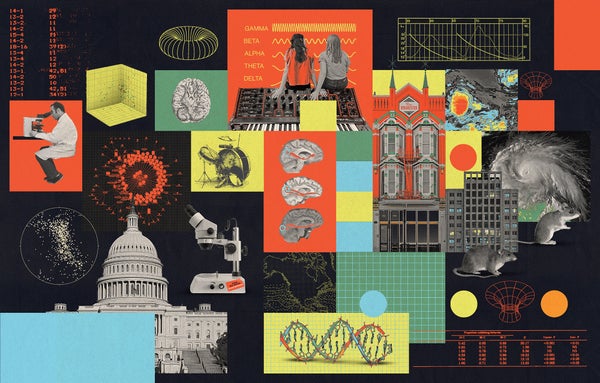
Aza Allsop is a physician, neuroscientist and musician studying how music affects our brains and, in turn, how it might be used to improve mental health. Music has long been considered a convener; Allsop’s work helps to show why. In a recent study, he and his colleagues found that when people sitting face-to-face heard pleasing bits of music, their brains became more biochemically active in areas associated with social processing. In addition to his work as an assistant professor in Yale’s department of psychiatry, Allsop runs the Center for Collective Healing at Howard University, which melds neuroscience and sociology to promote wellness, cooperation and peace. His nominator says that “he combines art, science and community to redefine culture and make social impact.”
Robert Boria
San Francisco State University
On supporting science journalism
If you're enjoying this article, consider supporting our award-winning journalism by subscribing. By purchasing a subscription you are helping to ensure the future of impactful stories about the discoveries and ideas shaping our world today.
Robert Boria studies the effects of climate change and urbanization on small mammals. He melds natural history, ecosystem models and population genomics to understand how animals have responded to ecosystem changes and human cohabitation in the past and how they might do so in the future. Boria’s nominators note that he blends disparate fields with ease and that he does this work without Ph.D. students at an institution where many students commute. His team’s work shows that scientific research can be accessible to everyone.
Colette Delawalla
Emory University, Stand Up for Science
Colette Delawalla’s nominator says simply, “She is changing the field of science, particularly among young scientists, by showing them how to become participants in democracy.” Delawalla, a clinical psychology graduate student at Emory University, has led a charge against cuts to science and the dismissal of evidence through her organization, Stand Up for Science. Since early last year she has convened scores of people to protest funding cuts, promote political candidates who support science, and work with and within government to preserve the role of science in evidence-based policymaking and the economy.
Daniel Clarke
Icahn School of Medicine at Mount Sinai
Daniel Clarke develops programs that enable scientists to mine the immense amount of data gathered through genomics, proteomics and other –omics. Being able to synthesize all that information helps scientists unravel the inner workings of a cell and how it goes awry in disease. Clarke, who has a master’s degree in computer science rather than a Ph.D., has been instrumental to research that has led to multiple high-impact publications. Yet researchers like him, who create the tools that scientists use every day, rarely get the recognition they deserve, says the scientist who brought him to Scientific American’s attention. He calls Daniel “phenomenal—the most creative, dedicated and knowledgeable member of the lab over the past five to six years.”
Xing Chen
University of Pittsburgh School of Medicine
Xing Chen is trying to understand how our brains process what we see in an effort to help people who are blind. She is working at the interface of neuroscience and biomedical engineering, using electrodes to stimulate visual systems to produce events the brain might interpret as shapes and letters—all without the information that comes from actual eyesight. Figuring out how to create these events is a step toward developing prosthetics that could at least partially restore vision in people who are blinded by accidents or glaucoma. Chen’s nominator says she “has made a tremendous impact in her field and beyond, performing at the cutting edge of innovation.”