
Pineapple on pizza and rain on weekends shouldn’t exist on Earth, yet somehow they do. And a mysterious cosmic particle that was detected in 2022 shouldn’t have made it to our planet either, but it did. Unlike the former two things, there may finally be an adequate explanation for how the particle got here.
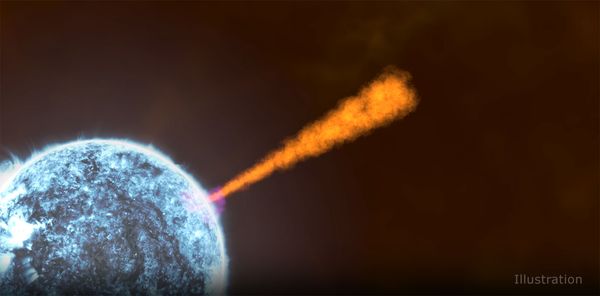
The tiny particle originated in an enormous gamma-ray burst two billion light-years away from Earth. The burst was so bright that researchers nicknamed it “BOAT” (“brightest of all time”).
When light particles, known as photons, from BOAT reached Earth on October, 9, 2022, researchers realized that one of those photons was not like the others.
On supporting science journalism
If you're enjoying this article, consider supporting our award-winning journalism by subscribing. By purchasing a subscription you are helping to ensure the future of impactful stories about the discoveries and ideas shaping our world today.
It was detected by Russia’s Carpet, an ultra-high-energy-cosmic-ray detector, and carried about 300 tera-electron-volts (300 trillion electron volts) of energy—making it the most energy-dense photon ever observed from a gamma-ray burst and far more powerful than anything produced by high-energy particle accelerators on Earth, such as the Large Hadron Collider.
According to the rules of standard physics, a photon with that much energy should have hit other light particles from the universe’s microwave background and been destroyed in the process. So how did it survive? In a new paper in Physical Review Letters, a pair of physicists say they may have the answer.
They propose that hypothetical ultralight particles called axionlike particles, combined with the high energy of the photon, which allowed it to behave in previously unobserved ways. Essentially, they argue that tiny particles with enormous amounts of energy may gain access to the universe’s fast lane, allowing them to avoid other particles that should absorb and obliterate them.
Under this theory, the photon should have arrived at Earth around an hour later than its less energetic counterparts from the gamma-ray burst. And it turns out that a Chinese observatory did, in fact, detect less energetic photons an hour earlier than the one picked up in Russia.
“The most interesting aspect of our work is that, for the first time, it brings together two ideas that until now had been developed separately,” said Marco Roncadelli, an astronomer at Italy’s National Institute for Nuclear Physics and a co-author of the study, in a statement. “If future observations confirmed this scenario, the Universe would become a natural laboratory for studying quantum gravity at energies enormously higher than those achievable by any accelerator built on Earth.”