
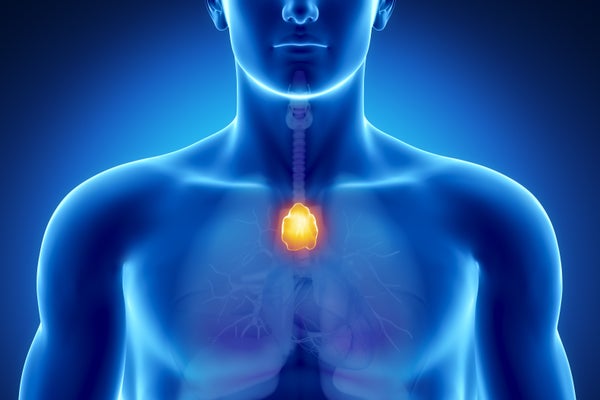
As far as organs go, the thymus is underrated. This little-known gland sits inside the chest next to the heart and the lungs. And while we typically retain it into adulthood, it is most active before and during puberty. At that time, the thymus is largely responsible for developing T cells, a critical type of white blood cell that help to fight infections. Its role in adults, however, has largely been overlooked for years, in part because it shrinks (and is replaced with fat tissue) as we age—a signal scientists had interpreted as meaning it was less relevant.
But now a pair of new studies suggest the organ may be far more important for our long-term well-being than we thought. The findings jibe with an emerging consensus that the immune system plays a major role in how well we age.
In one study published on Wednesday in the journal Nature, researchers used artificial intelligence to analyze around 27,000 patient computed tomography (CT) scans and medical records to reveal that the health of the thymus may be linked to whether an individual develops cardiovascular disease or lung cancer or dies from any cause.
On supporting science journalism
If you're enjoying this article, consider supporting our award-winning journalism by subscribing. By purchasing a subscription you are helping to ensure the future of impactful stories about the discoveries and ideas shaping our world today.
The finding is in an important “puzzle piece” for understanding long-term health, says the study’s senior author Hugo Aerts, a researcher at Mass General Brigham and a professor at Harvard Medical School and Maastricht University in the Netherlands.
The AI analysis found “enormous variation” in the health of the thymus between individual people, Aerts says. “In some people, it stayed very active until a very old age. And [in] other people, it actually declined very rapidly at a younger age.”
Importantly, thymus health correlated with a person’s overall health. People who had a healthy thymus tended to live longer and were less likely to develop lung cancer or cardiovascular disease—even after accounting for factors such as what someone’s age or sex was and whether they smoked—than people with a less healthy thymus.
And in a related study also published in Nature on Wednesday, Aerts and his colleagues found that, among cancer patients receiving immunotherapy, those who had a healthier thymus tended to have better treatment outcomes.
“What these two studies show is that almost this forgotten organ, the thymus, may actually play a very central role in our health throughout life,” Aerts says.
“Increasingly, different lines of research are converging on the idea that immune competence—particularly T-cell-mediated immunity—is a central determinant of healthy aging,” says María Mittelbrunn, an immunologist at the Spanish Research Council and a visiting professor at Columbia University. Previous research has shown that patients who had their thymus removed experienced worse health outcomes years later, for example.
The research isn’t conclusive, however. The studies identify a correlation between the thymus and long-term health outcomes—but not a causal effect. It’s possible that the thymus could be “acting as a proxy for overall physiological health,” Mittelbrunn says, rather than determining it.
Patients included in the new research who had better thymus health also tended to have lower inflammation. “This could suggest that what is really being captured is a broader state of low inflammation and better global organ function rather than a thymus-specific effect,” Mittelbrunn says. It’s also possible other organs could show a similar trend, she adds.
What remains “compelling” is the message that “a well-functioning immune system is likely one of the most impactful factors in maintaining health,” Mittelbrunn says.
Aerts says more research is needed to fully understand how thymus health affects longevity. But the studies offer “new knowledge,” he says, and send a signal that the thymus deserves more attention and research.
“It’s like, ‘Hey, this organ—we should not forget about it,’” he says.