
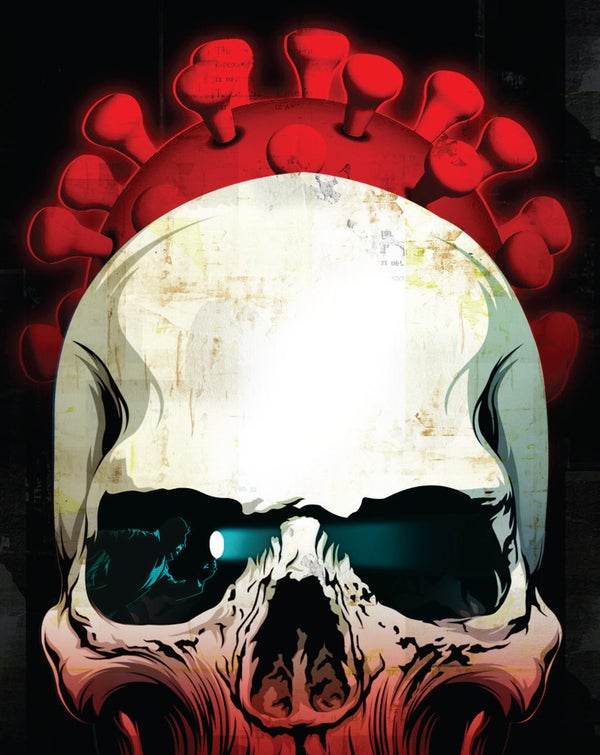
How many people in the U.S. have died from COVID? We know it is more than half a million, but the official count could miss tens of thousands of deaths. In TV police procedurals, the people who investigate premature deaths are depicted as highly trained, objective experts. In reality, the system in the U.S. is far less rigorous. The majority of states rely at least in part on coroners to rule on the circumstances surrounding unexpected or suspicious deaths—and contrary to what most of us probably believe, coroners are often laypeople without training in medicine. What is more, they are frequently elected officials, which makes them susceptible to political pressure from people or organizations looking to influence their conclusions. This system needs to be abolished.
The office of the coroner traces its origin to medieval England, where it was first established to help protect the financial interests of the crown. Death investigations were important because coroners collected the associated taxes, among other responsibilities.
Today most probes of the deaths of people who are not in the care of a doctor—including those who die at home or in police custody—are carried out by medical examiners and coroners. Medical examiners are physicians who are often board-certified in forensic pathology. Coroners are usually not physicians. In fact, in many states, coroners need only be of legal age with no felony convictions to qualify for the job. Yet they often have the final say on how someone died. There is no federal oversight of death investigation systems and no national standard to uphold. Instead states decide whether they use medical examiners or coroners, or a combination of the two—and determine the qualifications for the job. Most states have coroners in some or all counties.
On supporting science journalism
If you're enjoying this article, consider supporting our award-winning journalism by subscribing. By purchasing a subscription you are helping to ensure the future of impactful stories about the discoveries and ideas shaping our world today.
To make matters worse, nearly 80 percent of the nation's coroners are elected to the office. This arrangement exposes investigations to corruption and political influence. Elected coroners are beholden to voters, after all.
This relationship can have serious consequences for public health. Take, for example, the current coronavirus pandemic. SARS-CoV-2, the virus responsible for the disease, is a leading cause of pneumonia. When someone dies without having had a COVID test, a coroner may attribute the fatality to a direct cause, such as pneumonia, without mentioning COVID as the underlying cause on the death certificate. A recent analysis carried out for science news service STAT found that tens of thousands of deaths from COVID are going unreported, mostly in counties that supported former president Donald Trump. It also found that counties that use elected coroners had higher rates of uncounted COVID deaths than counties that use appointed medical examiners. “The figures suggest that political leanings have helped suppress the true scale of deaths,” STAT observed.
Voters are not the only source of influence on coroners. Death investigation has strong ties to law enforcement. Indeed, in many counties, the sheriff is the coroner. This arrangement poses obvious conflicts of interest. For instance, in 2017 public radio station KQED reported on the resignations of two forensic pathologists in San Joaquin County, California, who alleged that the sheriff-coroner interfered with their investigations into deaths that occurred during police arrest or custody to protect the officers involved. The sheriff assumes the duties of the coroner in 41 of California's 58 counties, according to the California State Association of Counties.
Leading medical and scientific organizations have long criticized the coroner system. As early as 1857, a committee of the American Medical Association recommended replacing elected coroners with court-appointed medical officials. In 1928 the National Academy of Sciences called for giving the medical duties of the coroner's office over to the medical examiner's office, which, the organization further argued, should be headed by a pathologist. The academy reiterated the need to move toward a medical examiner system in 2009. But the Centers for Disease Control and Prevention reports that just 16 states and Washington, D.C., have centralized medical examiner systems.
It is well past time to heed the experts' advice. Adopting a medical examiner system is not without challenges. For one, there are not enough medical examiners to go around. But with some of society's most pressing issues at stake, it has never been more important for states to lay the archaic coroner system to rest.