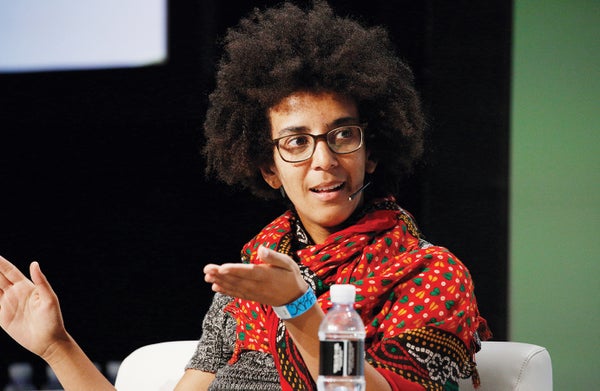
Timnit Gebru is a computer scientist, an engineer, and founder and executive director of the Distributed AI Research Institute, an independent organization conducting community-rooted research into technological tools and systems. She is also co-founder of Black in AI, a nonprofit that works to increase the presence, inclusion, visibility and health of Black people in the field of artificial intelligence. Gebru is the treasurer for AddisCoder, a nonprofit dedicated to teaching algorithms and computer programming to Ethiopian high school students.
An edited transcript of the interview follows.
How would you describe the current state of American science?
On supporting science journalism
If you're enjoying this article, consider supporting our award-winning journalism by subscribing. By purchasing a subscription you are helping to ensure the future of impactful stories about the discoveries and ideas shaping our world today.
I’m in the field of AI, and in my field, I would describe it as corporate-driven and sloppy. There are a lot of basic practices—for example, not testing on your training data, transparency, appropriate documentation—that are just not being followed. So it’s also misleading.
What needs to change in American science?
I think that, number one, the incentive needs to be decoupled from corporations or the military. The incentives need to be about primarily scientific curiosity but also people’s well-being. That’s the number-one thing: the funding needs to come from a different place. That’s where I’ll start and stop.
What gives you optimism right now?
The ingenuity of small organizations and younger people. I am constantly inspired by little, tiny organizations, such as a [New Zealand–based] company called Te Hiku Media. Using its small budget, it builds tools for language revitalization and a whole bunch of other things. We’ve tried to adopt some of its practices to our thing, and we are hoping somebody else can get inspired by us. So I’m inspired by how fast movements can spread like this, with small organizations talking to and inspiring one another.
One of the things they did was build their own cluster, which is kind of like a small data center, instead of using Google and Amazon and whatever other cloud services. It reminded me that there is a lot of stuff that you can do with a small budget. The constraints breed innovation. You can get very discouraged thinking about the amount of money and resources it takes to do science. So when you see these small organizations and what they are able to achieve with few resources, then you can be inspired to pursue a specific curiosity of yours with [limited] resources as well.
What’s your best advice for an early-career scientist?
Question everything, question the source of information that you get. Don’t believe any kind of hype that you hear from companies. Just follow all the rabbit holes. Being a scientist is really asking why and how and, Is this really true? So just have patience and ask all the questions. Don’t settle for answers that you get from the media. Question incentive structures, question where you’re getting the information from, and just don’t stop going down the rabbit holes when you’re doing experiments or asking questions.
That, to me, is like what science is about, right? You spend years and years and years still asking the same question or following a specific rabbit hole that other people are too tired to follow. And that’s really where there is no shortcut to scientific discovery or innovation. You have to struggle.
How has your field changed in the past few years?
I think, first, it has not only entered but overtaken the mainstream discourse.
For me, not just AI but the field of computer science as a whole was attractive because I was very excited about asking questions such as, What is the fastest way to do something? What is the most efficient way to do something? How few resources can I use to achieve this goal? How little memory can I use? You would have the brute-force way, which is the least complicated way, and then the clever way, which is where algorithms come in. It was always like solving a puzzle, and that was really exciting.
And then in the past few years, because of this corporate-driven agenda, we’ve seen kind of the opposite. If we pretend that we have all the data in the world, all the resources in the world, all the chips that one can ever get, what can we do? That’s not exciting to me, and I think you cannot innovate that way.