
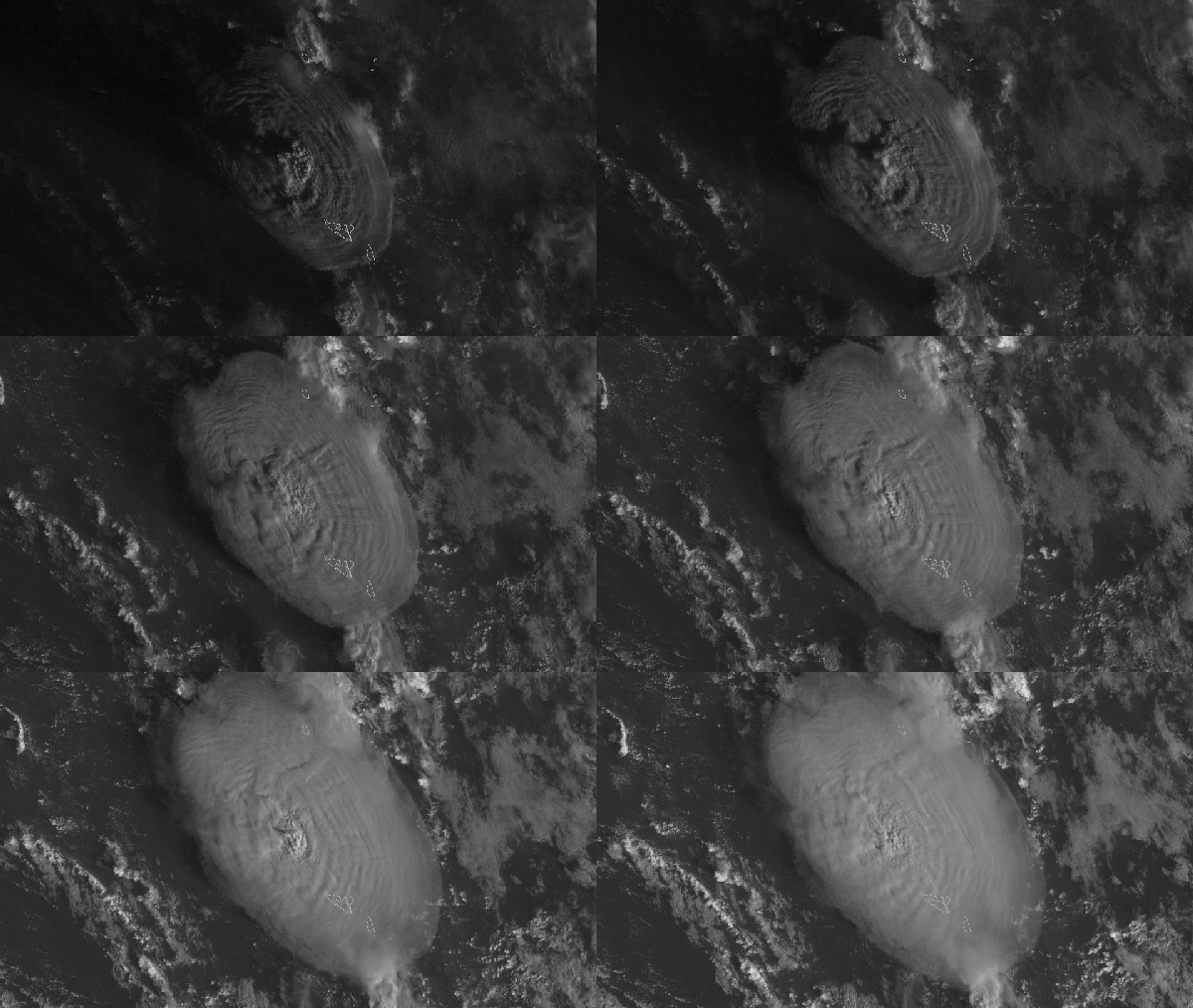
Scientists are racing to understand a puzzling series of massive ripples in Earth’s atmosphere triggered by the eruption of the Tongan volcano at the weekend. Satellite data shows that the event — which some fear might have devastated the Pacific-island nation — provoked an unusual pattern of atmospheric gravity waves. Previous volcanic eruptions have not produced such a signal, leaving experts stumped.
“It’s really unique. We have never seen anything like this in the data before,” says Lars Hoffmann, an atmospheric scientist at the Jülich Supercomputing Centre in Germany.
The discovery was made in images collected by the Atmospheric Infrared Sounder (AIRS), mounted on NASA’s Aqua satellite, in the hours after the eruption of the Hunga Tonga–Hunga Haʻapai volcano on 14 January.
On supporting science journalism
If you're enjoying this article, consider supporting our award-winning journalism by subscribing. By purchasing a subscription you are helping to ensure the future of impactful stories about the discoveries and ideas shaping our world today.
They show dozens of concentric circles, each representing a fast-moving wave in the gases of the atmosphere, stretching for more than 16,000 kilometres. The waves reached from the ocean surface to the ionosphere, and researchers think that they probably passed around the globe several times.
‘Nice concentric wave patterns’
“This instrument has been operating for something like 20 years now and we have never seen such nice concentric wave patterns,” Hoffmann adds.
Atmospheric gravity waves occur when air molecules in the atmosphere are vertically, rather than horizontally, disturbed in the air column. This can happen as wind picks up speed as it rises over a mountaintop, or as a result of convection in local weather systems.
The up-and-down waves transfer energy and momentum through the atmosphere, and often show their effects in the way in which they cause high clouds to form in a series of ripples.
In theory, the rapid updraft of hot air and ash from an erupting volcano into the upper atmosphere could trigger gravity waves on a much larger scale. But nothing like this has been observed with previous eruptions analysed since the AIRS instrument was launched in May 2002.
“That’s what’s really puzzling us,” says Corwin Wright, an atmospheric physicist at the University of Bath, UK. “It must have something to do with the physics of what’s going on, but we don’t know what yet.”
He and his co-workers suspect that a “great big, messy pile of hot gases” in the upper atmosphere might be what kicks the waves off. The hot gas is “going up high into the stratosphere and knocking the air around”, he says.
Eruption heard across the planet
The eruption of the Hunga Tonga-Hunga Haʻapai volcano was heard across the South Pacific, and even in parts of the United States. Ash has covered many regions of Tonga, but a loss of power, phone lines and Internet connectivity has made it difficult for aid agencies to assess the extent of injuries, fatalities and damage.
Wright, who was the first to spot the wave patterns in data supplied by Hoffmann, says that the images show what looks like a mixture of wave sizes and types.
The convection in the atmosphere seems to be “very complicated and bumpy, and it’s generating a whole family of things at the same time”, he says. “That is what we currently think is going on, but we’ve only been looking at it for a few hours.”
The discovery was prompted by a tweet sent to Wright on 15 January from Scott Osprey, a climate scientist at the University of Oxford, UK, who asked: “Wow, I wonder how big the atmospheric gravity waves are from this eruption?!”
Explosive speed
Osprey says that the eruption might have been unique in causing these waves because it happened very quickly relative to other eruptions. “This event seems to have been over in minutes, but it was explosive and it’s that impulse that is likely to kick off some strong gravity waves,” he says.
The eruption might have lasted moments, but the impacts could be long-lasting. Gravity waves can interfere with a cyclical reversal of wind direction in the tropics, Osprey says, and this could affect weather patterns as far away as Europe. “We’ll be looking very carefully at how that evolves,” he says.
The imagery and data collected from the eruption has been “spectacular” and has presented scientists with an exciting opportunity, says Vicki Ferrini, a marine geophysicist at Columbia University in New York City. But she adds that she and others remain deeply concerned for the people of Tonga, particularly given the absence so far of detailed information on the scale of the disaster.
Researchers in New Zealand say that they are closely monitoring the volcano for further eruptions. “We are just keeping our ears to the ground,” says Shane Cronin, a volcanologist at the University of Auckland. The volcano could be resupplied with large amounts of magma from deep underground and produce more explosive eruptions, he says. But if it has exhausted its main supply, it might produce only smaller eruptions, largely hidden beneath the surface of the ocean.
This article is reproduced with permission and was first published on January 18 2022.