
Update: On May 28 the NSF’s OAM removed from its database the note “Future Awards to Organization on Hold” for Duke, Harvard and Yale. And a few grants for researchers at Harvard and Duke have been released, according to agency staff members who spoke to Nature.
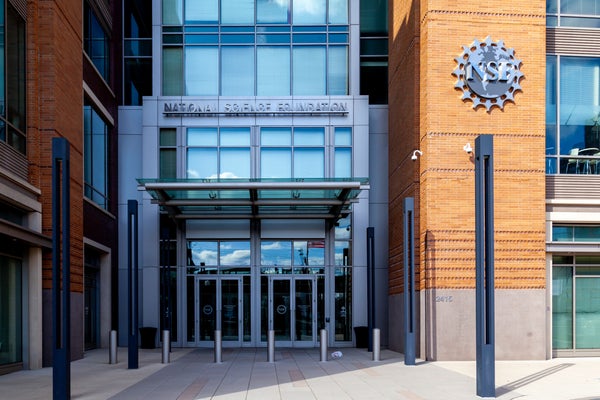
The US National Science Foundation (NSF) — a major funder of basic research — has restricted the flow of new research grants to a group of elite universities, Nature has learnt.
Internal agency documents obtained by Nature’s news team reveal that on 9 April, the NSF’s Office of Award Management (OAM), which finalizes grants and handles their finances, put limits on new funding to Duke University in Durham, North Carolina; Harvard University in Cambridge, Massachusetts; Princeton University in New Jersey; and Yale University in New Haven, Connecticut. A note applied to these universities in an NSF database reads: “Future Awards to Organization on Hold.” Since then, little fresh funding has been made available to these institutions by the NSF.
On supporting science journalism
If you're enjoying this article, consider supporting our award-winning journalism by subscribing. By purchasing a subscription you are helping to ensure the future of impactful stories about the discoveries and ideas shaping our world today.
It is unclear why the NSF, which has an annual budget of US$8.8 billion, is limiting new funding to these particular universities or when the restriction will end. The agency declined a request for comment from Nature.
Last year, the administration of US President Donald Trump froze or terminated research funding for several US institutions, alleging violations of federal anti-discrimination policy, such as a failure to protect students against antisemitism. Some institutions struck deals with the administration to restore funds. Harvard, which had about 75% of its research grants terminated by the NSF, sued. A federal judge ruled last September that the terminations were illegal and permanently banned US agencies, including the NSF, from taking similar action against Harvard in the future.
Legal scholars who spoke to Nature say that the latest restriction on new funding by the NSF could be in violation of that ruling. “The administration has bent itself into pretzels to continue actions against universities it dislikes, even in the face of court orders,” says David Super, a specialist in administrative law at Georgetown University in Washington DC.
The White House denied that the administration is taking action against the four universities.
Research on hold
An internal NSF list obtained by Nature shows that the OAM has stalled 33 research proposals by researchers from the four universities or their collaborators. Grant-making at the NSF has been slow this fiscal year owing to a 43-day government shutdown in late 2025 and the White House delaying the release of the agency’s budget, but inside the OAM, processing has been consistent, with research grants taking ten days to finalize, on average.
Proposals from scientists at Duke, Harvard, Princeton, Yale and their collaborators, however, have been held by the office for an average of 91 days. Many were stalled even before the 9 April hold was applied to these universities.
To arrive at the OAM, proposals must be evaluated and found meritorious by a panel of independent scientists, then endorsed by NSF programme officers and approved by agency leadership. Agency staff members who spoke to Nature on condition of anonymity, because they fear reprisal, say that the type of hold being placed on new funds to the four universities is rare and used only in extreme situations, such as when a university closes or fails an audit.
Scientists at Duke, Harvard, Princeton and Yale are frequent recipients of NSF grants; in 2024, these universities received a combined 218 new grants from the agency. At the moment, researchers on these grants are still able to access funds when needed. But new grants have been slowed to a trickle. So far this fiscal year, the four institutions have received 13 new grants combined. And no awards have gone to scientists at Duke or Harvard since the 9 April freeze.
Princeton’s dean for research, Peter Schiffer, said in a statement that the agency “has not informed us of any blanket action involving our pipeline of NSF-funded projects”. The other three universities did not respond to queries by the time this story was published.
University uncertainty
Researchers at the affected universities whose proposals are being held were reluctant to speak to Nature. None was aware of the block on new funding before Nature reached out to them.
About 85% of the stalled proposals are in mathematics, physical sciences and engineering, and several of them are about quantum information science, which the Trump administration has said it wants to prioritize. They include a five-year grant that would fund a promising early-career researcher, and one to support a quantum centre at Yale.
New grants might not be the only ones affected: at least one ‘continuing grant’ that receives money annually as part of a multi-year award is also in limbo. The Viral Emergence Research Initiative (VERENA), a multidisciplinary programme led by Yale that aims to predict the next pandemic threats, is still awaiting last year’s payment of more than $2 million from the NSF. Agency staff members told Nature that the increment was approved by a programme officer on 20 January, but is still waiting to be processed at the OAM. Disease ecologist Colin Carlson, who leads VERENA at Yale, says that many members of the 40-person team have left the programme and that he will have to lay off the remainder at Yale over the next few months if the money isn’t released.
Duke, Harvard, Princeton and Yale aren’t the only institutions being singled out by the NSF in 2026. Last month, the agency suspended 18 research grants to the University of California, Berkeley (UC Berkeley), as first reported by Berkeleyside, a non-profit news outlet.
The suspension letter sent to UC Berkeley by the OAM on 13 April, seen by Nature, alleges that the principal investigators for each of the grants failed to “properly disclose all sources of foreign funding” from countries including France, South Africa and the United Kingdom.
Markita Landry, a biochemist at UC Berkeley, is the lead investigator on one of the suspended grants, which proposed using nanoparticles to deliver molecular genome-editing tools into plants. The letter says that the suspension of her grant was due to undisclosed funding from the United Kingdom, which has baffled her: “I cannot recall any funding that I’ve ever had from the UK,” she says.
The NSF declined to comment about the suspension of grants at UC Berkeley.
This article is reproduced with permission and was first published on May 27, 2026.