
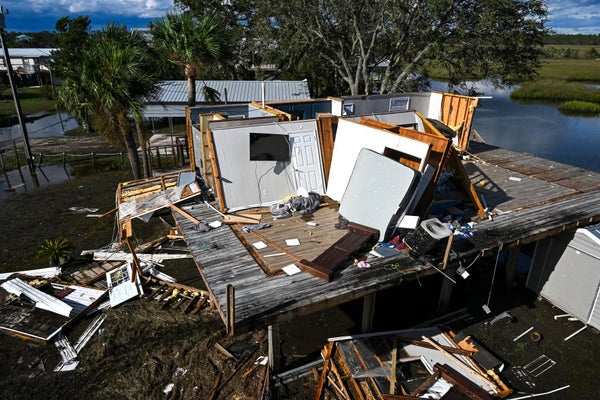
CLIMATEWIRE | A government auditor warned lawmakers Tuesday that the federal government likely will run out of money to cover disasters at the peak of hurricane season this year — imperiling its ability to pay for emergency shelters, home repairs and long-term rebuilding.
The warning at a congressional hearing came the day after President Joe Biden proposed a moderate increase in disaster spending next year. Even if the request is approved, however, it likely will be too little too late to prevent the disaster fund from going insolvent.
The Federal Emergency Management Agency, which runs the disaster fund, faced an identical situation last summer and had to restrict spending for five weeks, and halt funding for 2,400 rebuilding projects.
On supporting science journalism
If you're enjoying this article, consider supporting our award-winning journalism by subscribing. By purchasing a subscription you are helping to ensure the future of impactful stories about the discoveries and ideas shaping our world today.
“They’re in the same position as they were before,” Chris Currie, the Government Accountability Office’s director of homeland security and justice, told a House Transportation and Infrastructure subcommittee.
Spending restrictions “may be necessary again” this summer, Currie added.
FEMA itself said in a report Tuesday that its disaster fund, which currently has $20 billion, would run out of money in August and have a $7.2 billion deficit in September.
FEMA’s financial struggles are due to the rising number of disasters; Congress’ hesitance to add funding; and, according to a recent congressional report, the unpredictability of disasters, which makes accurate budget requests “a virtual impossibility.”
“FEMA is under increasing pressure to do more and more,” Currie told the House Subcommittee on Economic Development, Public Buildings and Emergency Management. “It takes a huge toll on the agency.”
One of the biggest financial drains has come from former President Donald Trump’s decision in 2020 to use the disaster fund to reimburse states for pandemic expenses. FEMA has spent $123 billion on pandemic response — far more than anyone had predicted — and projects the total spending will hit $144 billion by October.
Yet Congress has shown a reluctance to help. Biden asked Congress in October to give the disaster fund $9 billion on top of its annual appropriation, but lawmakers have taken little action, and some say approval is unlikely. The $9 billion supplemental funding could prevent the disaster fund from being depleted this summer.
Biden’s budget proposal for the fiscal year that starts Oct. 1 includes $22.7 billion for the disaster fund — a 14 percent increase from funding levels the past two years.
The additional $2.8 billion likely will be insufficient to close the $7.2 billion deficit that FEMA projects for its disaster fund. But the proposed increase is “the maximum allowable request” under a funding formula that relies heavily on disaster spending in previous years, according to an administration budget document.
As the disaster fund dwindled last summer and Biden asked Congress for emergency funds, FEMA in late August imposed spending restrictions for the first time in six years.
For five weeks, FEMA stopped approving new long-term rebuilding projects; cut off funding for projects that were underway; and spent money only on emergency disaster needs such as rescuing stranded people, opening shelters, and giving displaced households supplies and cash.
At the time, FEMA Administrator Deanne Criswell warned lawmakers that if they didn’t approve Biden’s request, the agency would run out of money “to cover all of our ongoing life-saving operations.” FEMA lifted the restrictions in early October after Congress approved new funding.
Reprinted from E&E News with permission from POLITICO, LLC. Copyright 2024. E&E News provides essential news for energy and environment professionals.