
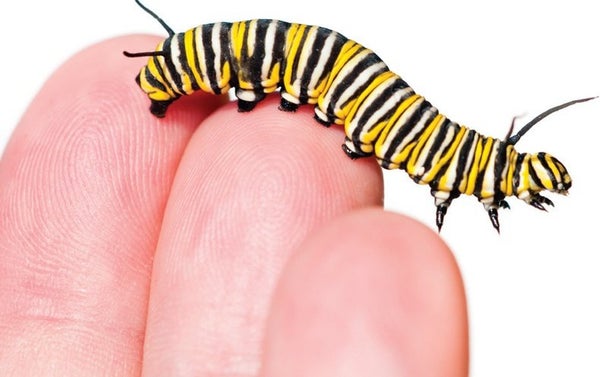
Every year millions of breeding monarch butterflies in the U.S. and southern Canada search for milkweed plants on which to lay their eggs. Concern over dwindling habitat has prompted conservationists to create monarch-friendly spaces along roadsides, which are abundant within the butterflies' range and usually publicly owned. But traffic noise stresses monarch caterpillars out, a new study finds. They eventually do become desensitized to it—but that might spell trouble for them later on, too.
Noise pollution is known to disrupt the lives of birds, whales and other creatures. But until recently, scientists had never tested whether it triggers a stress response in insects. When Andy Davis, a conservation physiologist at the University of Georgia, noticed online videos of roadside monarch caterpillars apparently shuddering as cars zoomed by, he wondered how the constant clamor might affect them. Davis built a custom caterpillar heart monitor, fitting a small sensor into a microscope to precisely measure monarch larvae's heart rates as they listened to recordings of traffic sounds in the laboratory.
The hearts of caterpillars inundated with highway noise for two hours beat 17 percent faster than those of caterpillars in a silent room. But the heart rates of the noise-exposed group returned to baseline levels after hearing the traffic sounds nonstop for their entire 12-day larval development period, Davis and his colleagues reported in May in Biology Letters.
On supporting science journalism
If you're enjoying this article, consider supporting our award-winning journalism by subscribing. By purchasing a subscription you are helping to ensure the future of impactful stories about the discoveries and ideas shaping our world today.
This desensitization could be problematic when the caterpillars become adults, Davis says. A rapid stress response is vital for monarch butterflies on their two-month journey to spend winters in Mexico, as they narrowly escape predators and fight wind currents. “What I think is happening [on roadsides] is their stress reactions get overwhelmed when they're larvae and [could be] impaired when they travel to Mexico,” Davis says.
Whether a noisy larval period reduces monarchs' survival rates remains unknown, notes Ryan Norris, an ecologist at the University of Guelph in Ontario, who was not involved in the study. But in any case, he believes roadside patches almost certainly drive up the butterflies' mortality as a result of collisions with cars. “There is so much potential road habitat for monarchs and other insects—it would be such a nice thing to capitalize on,” Norris says. “But you just can't get around the traffic.”
Davis adds: “I think roads and monarchs just don't mix.”