
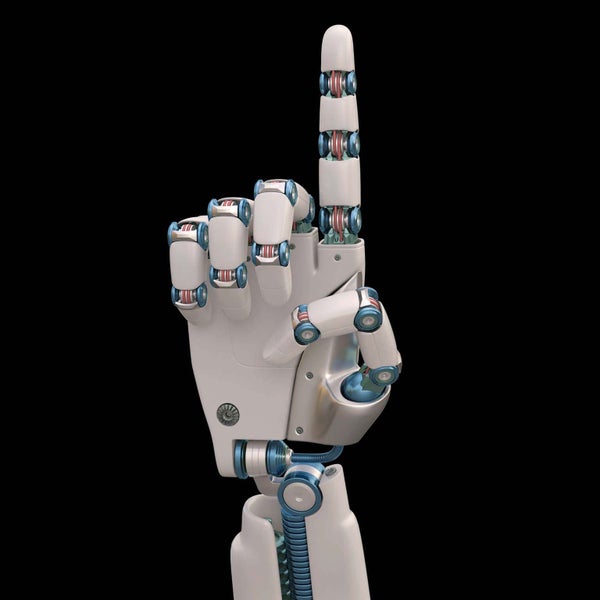
Robots of all shapes and sizes increasingly populate workplaces, from factories to operating rooms. Many of the bots rely on attaining new skills by trial and error through machine learning. A new method helps such skills transfer between differently shaped robots, avoiding the need to learn tasks from scratch each time. “Practically, it’s important,” says Xingyu Liu, a computer scientist at Carnegie Mellon University and lead author of the research, presented this past summer at the International Conference on Machine Learning. “And research-wise, I think it’s a cool fundamental problem to study.”
Let’s say you have a robot arm with a humanlike hand. You’ve trained its five fingers to pick up a hammer and whack a peg into a board. Now you want a two-fingered gripper to do the same job. The scientists created a kind of bridge of simulated robots between the two that slowly shifts in shape from the original form to the new one. Each intermediate robot practices the designated task, tweaking an artificial neural network until it reaches a threshold success rate, before the controller code is passed on to the next robot in the chain.
To transition between virtual source and target robots, the team created a shared “kinematic tree”—a set of nodes representing limb parts connected by links representing joints. To transfer hammer-whacking skills to the two-fingered gripper, the team adjusted the sizes and weights of the nodes for three of the fingers to zero. In each intermediate robot, the finger sizes and weights got a little smaller, and the network controlling them had to learn to adjust. The researchers also tweaked their training method so the leaps between robots weren’t too big or too small.
On supporting science journalism
If you're enjoying this article, consider supporting our award-winning journalism by subscribing. By purchasing a subscription you are helping to ensure the future of impactful stories about the discoveries and ideas shaping our world today.
The Carnegie Mellon system, called REvolveR (for Robot-Evolve-Robot), outperformed baseline training methods such as teaching the target robot from scratch. To reach a 90 percent success rate with the gripper, on the hammer task and in other experiments involving moving a ball and opening a door, the best alternative training method required from 29 to 108 percent more trials than REvolveR did, even though the alternative method used more informative training feedback. In further experiments, the researchers tested their process on other types of virtual robots, such as adding new leg sections to a spiderlike bot and having it relearn how to crawl.
“I think the idea is nice,” says University of Oxford computer scientist Vitaly Kurin, who studies robotics and machine learning and was not involved in the work. Although arranging challenges so an AI can transfer skills between tasks is not new, he says, “this interpolation from one robot to another one for transfer is something I haven’t thought of before.”