

More than 360 million years ago, during the Devonian period, life was flourishing in spectacular fashion. As fish and invertebrates populated the seas, the first trees emerged on land. But by the end of the Devonian, more than half of all Earth's species had disappeared in a series of mass extinctions. New research shows how tree evolution could have contributed to these extinction events.
As land plants diversified, “they started to grow more complex root systems that were able to reach farther [down] to grab water,” says U.S. Naval Academy oceanographer Matthew Smart, lead author of the new study in the Geological Society of America Bulletin. One type of tree, a proto-evergreen called Archaeopteris, even clustered into primitive forests. Deep tree roots drew crucial minerals such as phosphorus out of the bedrock and then eventually decayed, forming mineral-laden soil. Periodically, large quantities of this soil washed into the seas and lakes—where the sudden phosphorus influx triggered harmful algal blooms that pulled oxygen from the waters below.
The researchers tracked this deadly pattern in five prehistoric lake beds in Scotland and Greenland. They measured a gradual phosphorus decrease in sediment layers from the middle to late Devonian, punctuated by sudden spikes of the mineral with evidence of corresponding oxygen depletion.
On supporting science journalism
If you're enjoying this article, consider supporting our award-winning journalism by subscribing. By purchasing a subscription you are helping to ensure the future of impactful stories about the discoveries and ideas shaping our world today.
“We've been working on the Devonian for a long time, and we have been thinking that these cycles have occurred, but we couldn't really explain it,” says Anne-Christine Da Silva, a sedimentologist at the University of Liège in Belgium, who was not involved in the new research. “This paper could bring an explanation.”
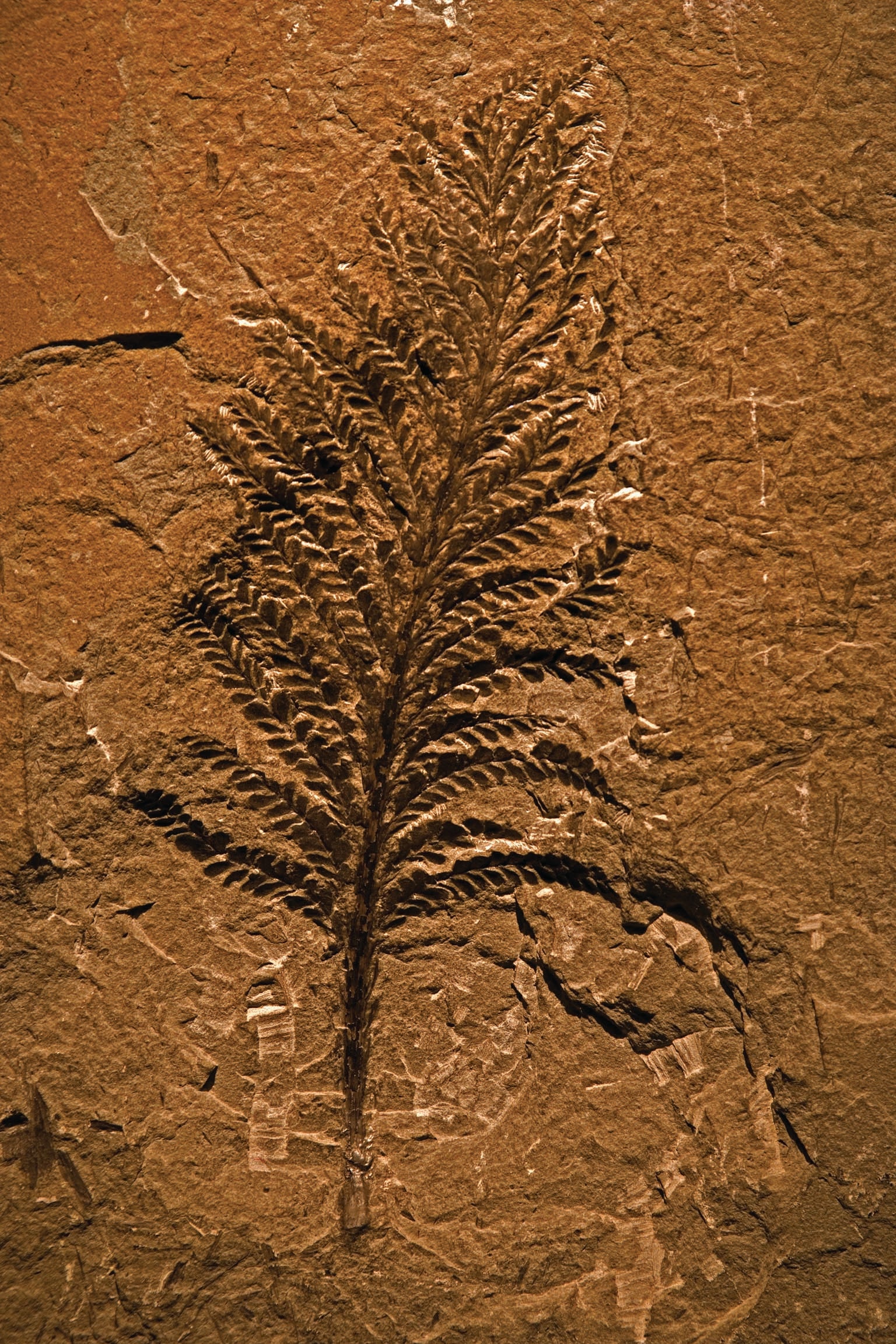
Fossilized Archaeopteris leaf. Credit: John Cancalosi/Minden Pictures
University of New Mexico planetary scientist Maya Elrick, who was also not involved in the study, says that while the oxygen depletion incidents coincided with extinctions, it is unclear how much of a role tree roots played. Phosphorus levels did gradually decrease overall as trees evolved, but she says this reduction may have already been occurring: “If it's a trend that was happening prior, you can't blame it on the plants.”
Other hypotheses link the Devonian extinctions to massive volcanic eruptions, meteor impacts or disrupted ocean currents. Next, Smart's team plans to test its results using computer models to see whether terrestrial plants could have caused ocean-wide oxygen depletion and corresponding extinction—analysis that could also help predict modern algal blooms' impact.
Harmful blooms are on the rise in places such as the Gulf of Mexico, where agricultural fertilizers run off into the water. This leads to “dead zones” devoid of dissolved oxygen. “Those who don't learn from history are doomed to repeat it,” Smart says. “In this case, we're studying history that's 400 million years old, but it can still teach us the same lessons.”