
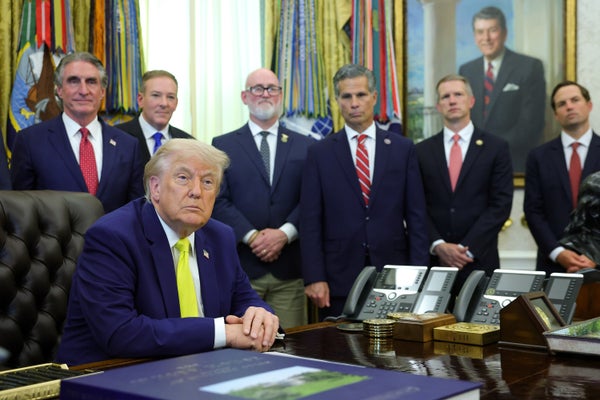
At a White House briefing on Thursday, President Donald Trump invoked a national defense law to steer nearly $700 million to support coal power plants and exports. Trump aims to use the 1950 Defense Production Act to refurbish 13 coal plants, build two new ones and establish a West Coast coal export facility in the U.S.—even as many coal plants around the country are retiring and the fossil fuel is in long-term decline.
“We’re into energy that really works,” Trump said at the briefing, claiming that coal firms would pay an additional $1.7 billion to support the new construction. The administration is also angling for existing coal plants in four states to remain operational past their retirement dates.
Coal and oil are already heavily subsidized, but the administration says that by reversing coal’s steady decline, it will create 14,000 new jobs. On Thursday the Environmental Protection Agency also announced it would reverse a 2014 regional haze ruling that was due to close a coal power plant in Wyoming.
On supporting science journalism
If you're enjoying this article, consider supporting our award-winning journalism by subscribing. By purchasing a subscription you are helping to ensure the future of impactful stories about the discoveries and ideas shaping our world today.
In 2025 Trump declared a National Energy Emergency aimed at bulwarking the coal industry. At the same time, the president has broadly opposed solar and wind power during his administration. Nevertheless, U.S. coal use has been in sharp retreat for almost two decades, accounting for only 8 percent of primary energy consumption nationwide in 2024, according to the Congressional Research Service. Its use is expected to decline further because of increased renewables and natural gas. Wind and solar produced a record 17 percent of U.S. energy in 2025 and are less expensive than fossil fuels. Natural gas, long touted as a “bridge fuel” to a cleaner economy, is also much more commonly used today than coal.
Environmental groups criticized Trump’s move. “Propping up coal billionaires with taxpayer money is one more way for the Trump administration to put polluters first and put the rest of us at risk,” said Kit Kennedy, managing director for power at the Natural Resources Defense Council, to the Associated Press.
Coal fuel is a major producer of greenhouse gas emissions, chiefly carbon dioxide, driving climate change. Its decline has contributed to less severe, although still dangerous, recent projections for future global warming. In February, however, the Trump administration scrapped the EPA’s 2009 “endangerment finding” that climate change threatened human health. At the time of the February decision, EPA administrator Lee Zeldin said that the action would lead to an average of $2,400 in cost savings per vehicle for consumers.
Editor’s Note (6/4/26): This story is in development and may be updated.