
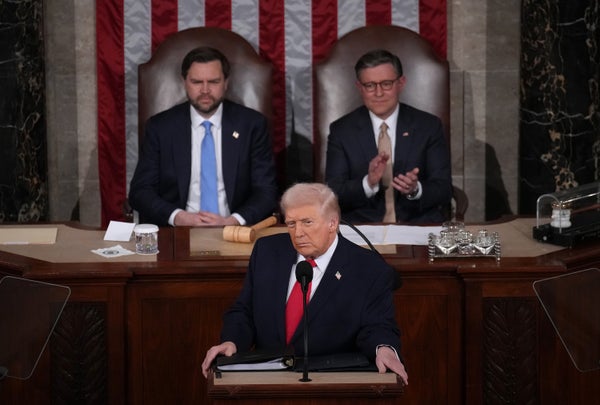
U.S. president Donald Trump’s record-long State of the Union speech on Tuesday ranged over topics from immigration to the economy to military strikes on Iran to crime. But one pillar of his administration’s second-term agenda was conspicuously missing: “Make America Healthy Again,” or MAHA.
Supporters of the MAHA movement, which has been led by Secretary of Health and Human Services Robert F. Kennedy, Jr., have championed the removal of ultraprocessed ingredients and additives from food and remade the national dietary guidance. Under Kennedy, the Department of Health and Human Services and its affiliated agencies have sought to overhaul drug development and endorsed, without evidence, skepticism toward vaccines. The Centers for Disease Control and Prevention upended its vaccine schedule earlier this year to reduce the number of diseases that it recommends children routinely get shots for from 17 to 11.
These moves have not been without controversy. Although childhood vaccination rates have declined worldwide since the COVID pandemic, routine childhood vaccines remain widely popular. Physicians and other medical experts seem to be ignoring the recent CDC changes to the vaccine schedule. The lack of MAHA in Trump’s Tuesday address and recent shake-ups among HHS leadership suggest the Trump administration may be deemphasizing MAHA and any antivaccine efforts ahead of the upcoming 2026 midterm elections.
On supporting science journalism
If you're enjoying this article, consider supporting our award-winning journalism by subscribing. By purchasing a subscription you are helping to ensure the future of impactful stories about the discoveries and ideas shaping our world today.
In the one-hour-and-48-minute speech, Trump spent fewer than five minutes on health care. The president mentioned TrumpRx, his signature prescription drug pricing program, and his desire to make in vitro fertilization (IVF) treatment more affordable. He did not mention the MAHA movement once.
The omission is notable, given the prominent role MAHA played in Trump’s presidential campaign and Kennedy’s sweeping actions during his first year as health secretary. But cracks have appeared in the MAHA movement in recent months. In addition to pushback against the vaccine schedule changes, some MAHA supporters have taken issue with Kennedy’s support for Trump’s recent executive order promoting the production of the weed killer glyphosate, which public health experts have deemed a “probable carcinogen.”
MAHA has not been entirely eclipsed, however. On Wednesday Trump’s surgeon general pick Casey Means appeared before a Senate committee for a confirmation hearing. Means is a prominent MAHA advocate and has previously been critical of the food and drug industries for minimizing how much a healthy diet can help to prevent disease, a cornerstone belief of the MAHA movement.
Ahead of Trump’s speech, some Republicans had expressed fear that they could suffer significant electoral losses in the midterms. It remains to be seen whether the Trump administration will veer away from the more controversial aspects of Kennedy’s agenda and refocus on areas such as nutrition, which are broadly popular.