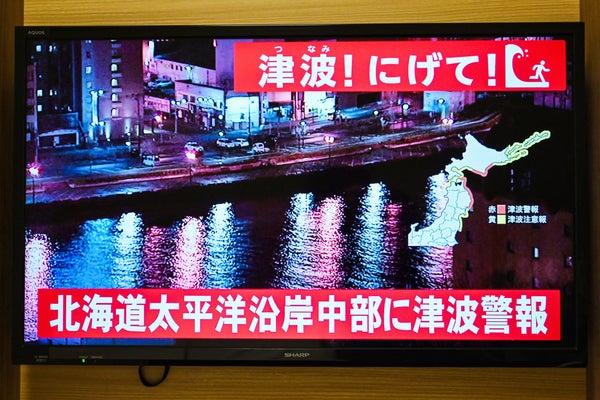
Japanese officials issued tsunami warnings and evacuation orders for the country’s northeast coast on Monday after a magnitude 7.6 earthquake struck 80 kilometers off the coast at 11:15 P.M. local time. An Initial tsunami has been observed in some areas, with waves of half a meter hitting the worst-affected regions.
Railway service has been suspended in the area and thousands are reportedly without power, but so far, no issues have been reported at any nuclear power plants, according to Reuters.
Japan experienced a devastating tsunami and a catastrophic disaster at the Fukushima Daiichi nuclear power plant after a magnitude 9 earthquake hit in 2011. That earthquake was the fourth-largest ever recorded, according to the U.S. Geological Survey. The tsunami it created reached up to 40.5 meters.
On supporting science journalism
If you're enjoying this article, consider supporting our award-winning journalism by subscribing. By purchasing a subscription you are helping to ensure the future of impactful stories about the discoveries and ideas shaping our world today.
Japan is one of the most earthquake-prone countries on Earth because of its location along the Pacific “Ring of Fire,” where tectonic plates grind against one another.
The U.S. National Tsunami Warning Center has said there are currently no tsunami concerns for the U.S. or Canada.
Editor's note: This is a developing story and may be updated.
Subscribe to Support Independent Journalism
Great science journalism requires human expertise, time, effort and creativity. And it costs money. That’s why I and the journalists here at Scientific American hope you’ll join our community.
When you subscribe, you are supporting staff and freelance journalists who are passionate about telling science stories that are true, important and compelling. Our editors and reporters are often experts in their fields, which means they understand the nuances of big discoveries and can untangle the breakthroughs from the hype. With a subscription, you are also supporting rigorous fact-checking to ensure the words we publish are precise and accurate. And you’re supporting original illustrations, graphics and photos that bring you closer to an advanced laboratory, an ice sheet in Antarctica or a space mission in orbit. You’re helping us craft other types of high-quality journalism as well: Our newsletters are carefully written, edited and curated by staffers you have or will come to know and love. Our Science Quickly podcast is based on original reporting, collaboration with editors and scientists and exacting production.
Subscriptions keep this engine running so we can continue to deliver thoughtful, rigorous and independent science journalism to you. In an era of viral misinformation, this work is crucial. If you value what we do, I hope you’ll consider joining us as a subscriber