
Key concepts
Physics
Sound wave
Frequency
Pitch
Introduction
Did you know the modern guitar is an instrument that dates back more than 4,000 years? The first written guitar music was published in the 16th century, during a time when guitars still had strings made from animal intestines! Although guitars have a long history, they are still extremely popular in modern day music. Have you ever wondered how they make the music you listen to everyday? In this activity we’ll make our own guitars and test the different sounds we can create.
Background
Sounds travel to our ears as sound waves—vibrations in the air we perceive as sound. These waves are generated by the vibration or movement of an object in a medium. They most commonly reach us by traveling via the air, although they can also pass through liquids and solids—that’s why you can hear things underwater or if you press your ear up against a wall. A vibrating object, such as a tuning fork, generates a sound wave. The fork’s vibrations cause the air particles around it to vibrate at the same frequency. These air particles bump into the air particles around them, and the sound wave propagates outward from the tuning fork.
On supporting science journalism
If you're enjoying this article, consider supporting our award-winning journalism by subscribing. By purchasing a subscription you are helping to ensure the future of impactful stories about the discoveries and ideas shaping our world today.
When a guitarist plucks a guitar string it vibrates at a specific frequency, which determines the pitch of the sound we hear. Faster vibrations produce higher-pitched sounds. Children generally have smaller, thinner vocal cords that vibrate much faster than those of adults. As a result children’s voices sound much higher.
In this activity you will build your own guitar and explore how frequency changes the pitch of the sound we hear. Time to tune up!
Materials
Four rubber bands of varying thickness but the same length
Glue
Packing tape (or other strong tape)
Empty tissue box
Scissors
Two large craft sticks
Empty paper towel tube
Preparation
Remove the plastic inside the hole of the tissue box.
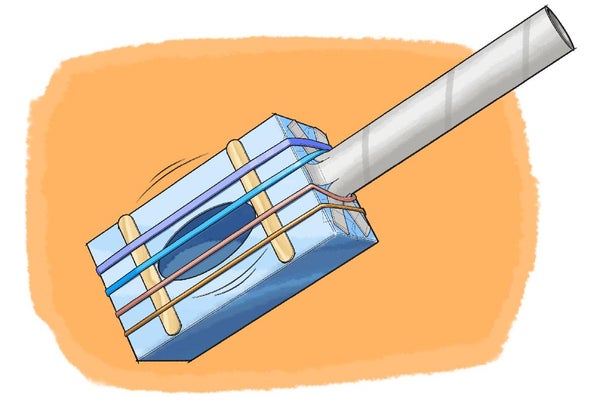
Use the tape to attach the paper towel tube to one short end of the tissue box. Make sure it is lined up with the box’s hole.
Glue a craft stick to each end of the hole in the tissue box. The sticks should be perpendicular to the direction of the hole and close to its edges. Allow the glue to dry.
Procedure
Wrap each rubber band around the tissue box lengthwise so they rest on the craft sticks. The rubber bands can cross over the hole in the tissue box top, but they don’t need to as long as they’re resting on the craft sticks.
Hold your guitar by the paper towel roll, and gently pluck each rubber band. Do all of the rubber bands sound the same? If not, which makes a higher-pitch sound, the thin or thick rubber bands? In addition to sound, can you feel anything happening when you pluck the rubber bands?
Choose one rubber band and pluck it. Listen carefully to the sound it makes. Press your finger down on the rubber band so that it is pinched between your finger and one of the craft sticks. Does the sound change when your finger is pressed on the rubber band? If so, what changes about it?
Try pressing each rubber band down on the craft stick. Notice how this changes the sound the rubber band makes.
Extra: Try increasing the size of the tissue box hole. How does this change the sound?
Observations and results
The sound made by your instrument was the sound created by the rubber band vibrating when you plucked it, much like how a real guitar string vibrates when played by a musician. As you strummed the strings of your instrument you might have noticed you could feel the vibrations of the rubber band traveling through the tissue box.
The thickness of the rubber band changed the tone of the sound you heard when you plucked it. The thinner strings on a guitar make a higher-pitch sound because they can vibrate more quickly than the thicker ones. The thinner strings on your rubber band guitar are the same—they vibrate more quickly, and we perceive these vibrations as a higher-pitched sound.
When you held the rubber band down the sound changed and eventually there was no sound at all. From this you could observe the sound was created by the rubber band—and when you prevented the rubber band from moving you couldn’t produce any sound.
In addition, in this activity you should have noticed you could change the pitch of the sound by pressing down on the rubber band. When you pressed down on it, the vibrating section of the rubber band got shorter. As a result the pitch of the sound got higher.
More to explore
Music for Martians: Build and Play a Theremin Instrument, from Science Buddies
Sound Science: Make Your Own Harmonica!, from Scientific American
Making Sound Waves, from Scientific American
Science Activities for All Ages!, from Science Buddies
This activity brought to you in partnership with Science Buddies
