
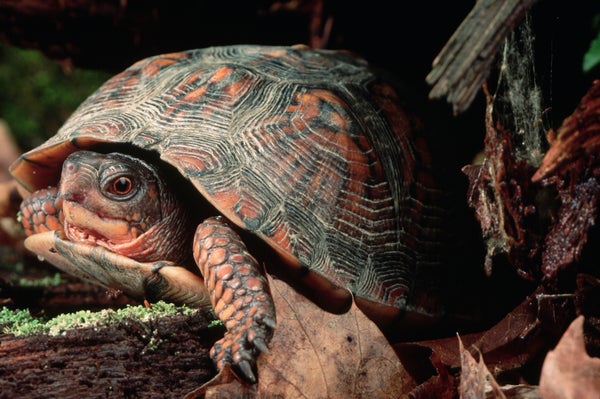
The invention of the atom bomb has shaped both history and ecosystems across the globe. Its far-reaching impacts have even led scientists to consider using the signature of nuclear weapons to mark a new geologic age, the Anthropocene. Now a new study has shown that turtles taken from nuclear production and detonation sites encode the history of these weapons in their shell.
Using a special mass spectrometer, a device that detects the chemical makeup of a material, scientists detected minuscule levels of uranium in the shells of four turtles, including one sea and one tortoise, that lived near such sites before they were collected as natural history specimens between the 1950s and 1980s. In these samples—two taken from production sites and two taken from detonation sites—the scientists matched the signatures of uranium isotopes in the shells to the distinct profiles produced by each of these two types of nuclear activity. (Isotopes are varieties of an element that contain different numbers of neutrons in their core.) And in one of the turtle shells, the researchers traced varying levels of uranium in individual concentric layers that formed like tree rings and tracked the animal’s uranium uptake over time. The results were published on August 22 in PNAS Nexus.
The fission, or splitting, of radioactive elements such as uranium and plutonium gives nuclear weapons their power. Such a weapon’s creation and detonation also shed these elements, however. Once in the environment, the elements are taken up into the local ecosystem, particularly via soil and water, where plants and eventually animals can consume them. The shells that the team analyzed weren’t radioactive because the uranium occurred in such small amounts, around one part in one billion, says study co-author Cyler Conrad, an earth scientist at the Pacific Northwest National Laboratory. The health of these particular animals, which managed to survive the nuclear exposure, also likely wasn't affected, he says.
On supporting science journalism
If you're enjoying this article, consider supporting our award-winning journalism by subscribing. By purchasing a subscription you are helping to ensure the future of impactful stories about the discoveries and ideas shaping our world today.
Finding uranium in turtle shells is not necessarily surprising on its own because the element occurs naturally. But Conrad and his colleagues were stunned that they were able to detect such tiny amounts of uranium and could match the isotope signature to the site’s nuclear history. Conrad hopes that the technique, which he and his team are adapting for use with plutonium, can help scientists understand where and when nuclear activity occurred and how radioactive materials move from soil and water into plants and animals. He also expects that it could trace exposure to nuclear fuel as well as weapons.
For Laura Martin, an environmental historian at Williams College, who was not involved with the new research, the study is a reminder of the scars the U.S. nuclear program—and not just those in Japan, where the U.S. deployed nuclear bombs as weapons. Production and experimental detonations also sent radiation and other pollution into American neighborhoods and ecosystems, particularly in the West and often on or near Indigenous lands, as well as in the Marshall Islands. “This paper points us to how nuclear colonialism is not just a human history,” Martin says, “but it has and continues to impact the whole biosphere.”
A version of this article with the title “Bomb Shell” was adapted for inclusion in the November 2023 issue of Scientific American.