
CLIMATEWIRE | Fox, Alaska, is a tiny town, but on Monday it hosted one of the Pentagon’s senior officials for a unique tour.
Deputy Defense Secretary Kathleen Hicks was there to see 360-foot-long tunnel that military engineers dug into the frozen ground more than 50 years ago. Its purpose is to help scientists and Pentagon officials better understand permafrost — and its research is growing in importance as the world warms.
Climate change is rapidly altering the Arctic landscape, in particular the permafrost that serves as a foundation for buildings across the region. Warming temperatures are thawing out the frozen ground, and in the process it is threatening to unsettle structures that were built decades ago.
On supporting science journalism
If you're enjoying this article, consider supporting our award-winning journalism by subscribing. By purchasing a subscription you are helping to ensure the future of impactful stories about the discoveries and ideas shaping our world today.
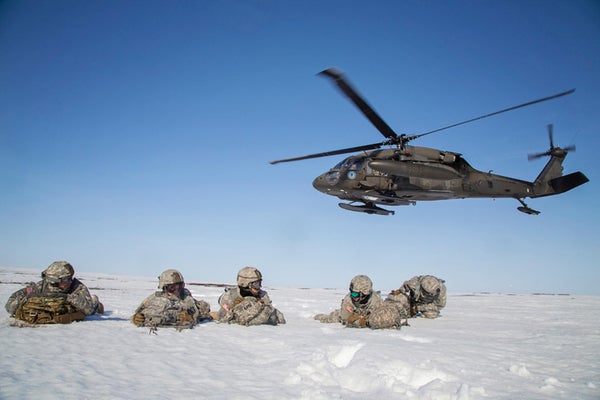
That's particularly worrisome for the U.S. military, which maintains facilities across the Arctic region. And it's one reason Hicks embarked on a two-day tour of the nation’s northernmost military bases.
“Building and maintaining infrastructure — like runways — on permafrost presents unique challenges for Arctic nations — which are growing with the effects of climate change,” Hicks wrote in a Twitter post on Monday.
That's not the only concern. Melting Arctic sea ice is opening new shipping lanes, and that's attracted the notice of China and Russia, two of America's biggest geopolitical rivals.
“The Arctic is incredibly strategically important. We can reach just about any theatre in the northern hemisphere from Alaska,” Pentagon spokesperson Eric Pahon, who is traveling with Hicks, said in a telephone interview. “We have to be able to operate and support (military personnel and assets) in those theaters.
Defense readiness also involves adapting military vehicles to operate in variable conditions ranging from extreme cold to extreme wet. "We’ve seen what the effects of an early spring thaw can do in Ukraine,” said Pahon, referring to muddy conditions that have slowed troop and vehicle movement.
Robert McCoy, director of the Geophysical Institute at the University of Alaska, Fairbanks, which was created by Congress in 1946 and works closely with the Defense Department on environment and climate issues, said that beyond thawing permafrost — which may be the Pentagon’s most immediate problem — DoD assets also are affected by shoreline erosion and more frequent flooding.
Also buildings, pipelines and other infrastructure built atop pilings require what’s called “passive refrigeration” to keep thawing permafrost from destabilizing the structures.
“The Air Force is spending a lot of money in Alaska to deal with this problem,” McCoy said. “There’s two F-35 [advanced fighter] squadrons at Eielson [Air Force Base] and a half-billion dollars in investment to host those squadrons,” including 36 new buildings and 54 aircraft hangers, according to the Defense Department.
During her visit, Hicks also stopped by the Ted Stevens Center for Arctic Security Studies to learn how experts are advancing U.S. interests through new security and research partnerships with other Arctic nations. Officials at the Stevens Center declined to comment on the visit, citing Pentagon media policies.
Pahon said those regional partnerships will allow the U.S. to learn from allied nations about optimizing base operations and mission readiness in the polar region.
“Some of the questions we’re trying to answer is: ‘How do you get an F-35 to safely fly in below-50 degree temperatures?' [And] 'what happens to an Abrams tank when you take it out into 50-below weather and try to fire it?'" he said. “There’s a lot of great training already happening up here, but we can always learn more from our regional partners.”
Reprinted from E&E News with permission from POLITICO, LLC. Copyright 2023. E&E News provides essential news for energy and environment professionals.