
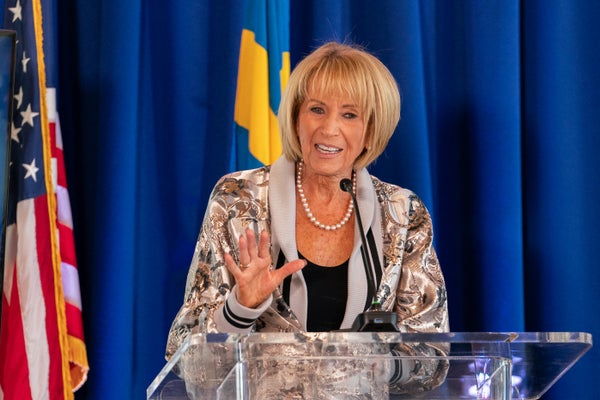
The past year has been “filled with turmoil” in science policy, National Academy of Sciences (NAS) president Marcia McNutt said on Tuesday during the annual State of the Science address in Washington, D.C.
McNutt cited problems such as “uncertainty” over federal support for science, “abrupt downsizing” of science agencies, a mass exodus of federal employees and the fact that the world’s top scientific minds are leaving the U.S.
“We always were the country where STEM talent came to us,” McNutt said, referring to science, technology, engineering and math fields. “Now we are exporting our science talent elsewhere.” After about 10 years as president of NAS, McNutt plans to step down on June 30.
On supporting science journalism
If you're enjoying this article, consider supporting our award-winning journalism by subscribing. By purchasing a subscription you are helping to ensure the future of impactful stories about the discoveries and ideas shaping our world today.
Since President Donald Trump took office last year, U.S. science has been a target for funding cuts, firings and intense regulatory scrutiny. By one estimate, around 100,000 federal employees at scientific agencies have either been fired or left public office in his second term. The administration has also cut nearly 8,000 scientific grants, mostly from the National Institutes of Health and the National Science Foundation, according to a Nature analysis published in January (some grants have since been reinstated by the courts).
And just last week, as Scientific American reported, the administration published a proposal to give political appointees final say on grant funding instead of researchers, overturning a decades-long precedent. “Now, what could possibly go wrong with that?” McNutt quipped on Tuesday.
“Frustrated and demoralized as many of us are right now, we must consider what is in our power, as a research community, to improve while, at the same time, pushing back against inappropriate political interference in research,” she said.
To make science more “resilient” and “competitive,” McNutt said that scientists should partner with industry—and that universities should support researchers who do so. And she urged scientists to train students to take science-adjacent jobs outside of academia.
Without bridging the gap between industry and science, she warned, the “best and brightest” students may “shun” careers in science, “domestic talent” will continue to seek opportunities abroad, and the economy will suffer.
The speech was met with some skepticism from scientists and science advocates who called attention to the threats facing U.S. research. “This focus on the private sector as we are facing down complete and total destruction of actual SCIENCE is unreal to me,” wrote Colette Delawalla, founder and CEO of Stand Up for Science, in a post on Bluesky. “We are doing publicly-funded free training for companies ... this is the selling out of science to the Tech Bros,” she added.
McNutt also recommended cutting red tape and lowering regulatory hurdles for researchers, as well as furthering reliance on artificial intelligence to “increase the rate of discovery.”
“Innovation is the only way that the U.S. research enterprise is going to remain at the top globally,” McNutt concluded. “Innovation shouldn’t just be a lofty aspiration; it should be our baseline expectation for our research enterprise.”
Disclosure: Jackie Flynn Mogensen was the recipient of a 2024 award that was given in part by the National Academies of Sciences, Engineering, and Medicine and included a cash prize.