New Issue: Orbital Catastrophe Ahead? Read Now

U.S. Sunscreens Aren’t Great. The FDA Could Soon Change That

The U.S. is considering allowing bemotrizinol, a highly effective UV filter used throughout Europe and Asia, in its sunscreen products for the first time

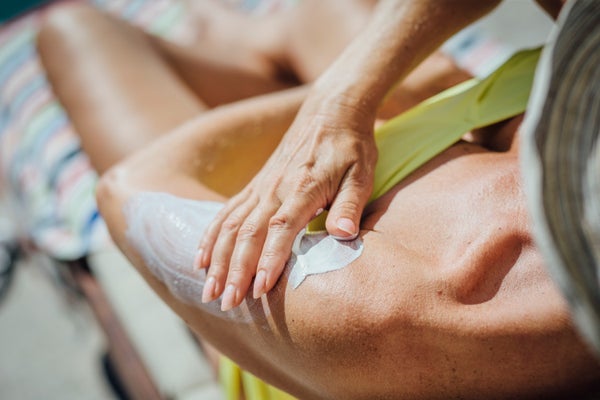
Mature woman lying on a deck chair by the pool. She is rubbing sun lotion into her arm.

iStock/Getty Images Plus

Join Our Community of Science Lovers!

Sunscreens in the U.S. could be in line for a long overdue update. On Thursday the U.S. Food and Drug Administration announced a proposal to permit the use of bemotrizinol, a broad-spectrum ultraviolet (UV) chemical filter. The ingredient is well known for its effectiveness and is already used in many popular sunscreen brands produced in other parts of the world, such as Asia and Europe. That’s why social media is rife with “sunscreen haul” videos of Americans showing off their Asian- and European-made lotions and sprays.

In the announcement, FDA Commissioner Marty Makary said that the agency “has historically moved too slowly in this area, leaving Americans with fewer options than consumers abroad.” Compared with Europe’s more than 30 approved UV-filtering ingredients, the U.S. has only 16, with the last active ingredient approved in 1999. Bemotrizinol was approved in Europe in 2000 and has been shown to be safe and effective. Sunscreens with bemotrizinol also tend to have a lighter weight and to be longer lasting and less greasy than those with other ingredients.

The proposal, which comes after years of attempts to overhaul U.S. sunscreen regulation, would allow sunscreen products with bemotrizinol to be sold over the counter in the U.S., perhaps bringing an end to the criticism that the country has lagged behind on sunscreen.


On supporting science journalism

If you're enjoying this article, consider supporting our award-winning journalism by subscribing. By purchasing a subscription you are helping to ensure the future of impactful stories about the discoveries and ideas shaping our world today.


Part of the reason why the U.S. has seemed behind Europe and Asia on sun protection is because the FDA treats sunscreen as a drug, which means that it is tightly regulated and that new products need to be extensively tested, dermatologist Samer Jaber told Scientific American in 2023.

Sunscreen protects people from harmful UV rays from the sun that can cause skin cancer. Mineral sunscreens effectively “block” the sun’s radiation from penetrating the skin, while chemical sunscreens sink into the skin and absorb the rays. Some chemical sunscreen ingredients are effective in filtering out UVA, or longer-wave ultraviolet light from the sun, while others are more attuned to shorter UVB waves. Bemotrizinol can filter both, offering broad-spectrum protection. The FDA says that sunscreen with a sun protective factor (SPF) of 15 or higher helps prevent sunburn and reduces skin cancer risk.

Lauren J. Young is a science journalist and multimedia producer based in New York City. She was formerly associate editor for health and medicine at Scientific American and has edited and written stories that tackle a wide range of subjects, including the COVID pandemic, emerging diseases, evolutionary biology and health inequities. Young has nearly a decade of newsroom and science journalism experience. Before joining Scientific American in 2023, she was an associate editor at Popular Science and a digital producer at public radio’s Science Friday. She has appeared as a guest on radio shows, podcasts and stage events. Young has also spoken on panels for the Asian American Journalists Association, American Library Association, NOVA Science Studio and the New York Botanical Garden. Her work has appeared in Scholastic MATH, School Library Journal, IEEE Spectrum, Atlas Obscura and Smithsonian Magazine. Young studied biology at California Polytechnic State University, San Luis Obispo, before pursuing a master’s at New York University’s Science, Health & Environmental Reporting Program.

More by Lauren J. Young

Subscribe to Support Independent Journalism

Great science journalism requires human expertise, time, effort and creativity. And it costs money. That’s why I and the journalists here at Scientific American hope you’ll join our community.

When you subscribe, you are supporting staff and freelance journalists who are passionate about telling science stories that are true, important and compelling. Our editors and reporters are often experts in their fields, which means they understand the nuances of big discoveries and can untangle the breakthroughs from the hype. With a subscription, you are also supporting rigorous fact-checking to ensure the words we publish are precise and accurate. And you’re supporting original illustrations, graphics and photos that bring you closer to an advanced laboratory, an ice sheet in Antarctica or a space mission in orbit. You’re helping us craft other types of high-quality journalism as well: Our newsletters are carefully written, edited and curated by staffers you have or will come to know and love. Our Science Quickly podcast is based on original reporting, collaboration with editors and scientists and exacting production.

Subscriptions keep this engine running so we can continue to deliver thoughtful, rigorous and independent science journalism to you. In an era of viral misinformation, this work is crucial. If you value what we do, I hope you’ll consider joining us as a subscriber

Thank you,

Jeanna Bryner, Editor in Chief, Scientific American

Subscribe