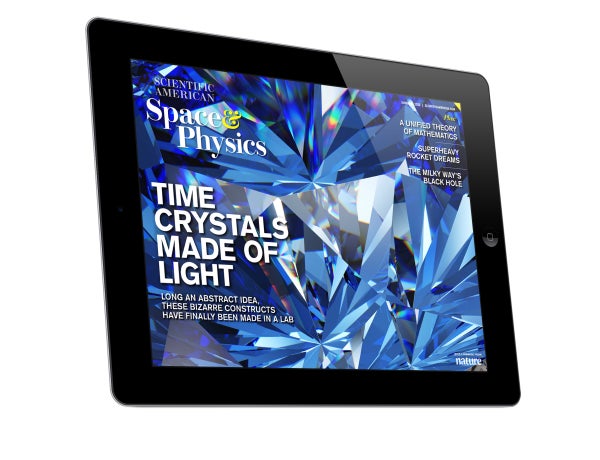
Scientific American Space & Physics, June/July 2022
Join Our Community of Science Lovers!
On supporting science journalism
If you're enjoying this article, consider supporting our award-winning journalism by subscribing. By purchasing a subscription you are helping to ensure the future of impactful stories about the discoveries and ideas shaping our world today.
Not even six months ago astronomers achieved a major milestone by successfully launching the shiny new James Webb Space Telescope. This summer we expect the observatory to start streaming data back to Earth, sharpening our eyes on the cosmos. And in May a planet-spanning, state-of-the-art observational tool—the Event Horizon Telescope—yielded the first image of the black hole at the center of our own Milky Way galaxy, Sagittarius A*. Chief features editor Seth Fletcher attended the announcement of the image in Washington, D.C. (see “The First Picture of the Black Hole at the Milky Way’s Heart Has Been Revealed”). You can also go online to learn more about why the picture looks like it does and listen to Fletcher explain the science behind capturing the black hole. Never before have our sights been so trained on the astounding universe.
And we’re just at the start. Next-gen rocket ships herald even more revolutionary space telescopes and bold space missions, as writer Jonathan O’Callaghan reports in this issue (see “SpaceX’s Starship and NASA’s SLS Could Supercharge Space Science”). Keep your eyes open—big space discoveries are heading our way.
Subscribe to Support Independent Journalism
Great science journalism requires human expertise, time, effort and creativity. And it costs money. That’s why I and the journalists here at Scientific American hope you’ll join our community.
When you subscribe, you are supporting staff and freelance journalists who are passionate about telling science stories that are true, important and compelling. Our editors and reporters are often experts in their fields, which means they understand the nuances of big discoveries and can untangle the breakthroughs from the hype. With a subscription, you are also supporting rigorous fact-checking to ensure the words we publish are precise and accurate. And you’re supporting original illustrations, graphics and photos that bring you closer to an advanced laboratory, an ice sheet in Antarctica or a space mission in orbit. You’re helping us craft other types of high-quality journalism as well: Our newsletters are carefully written, edited and curated by staffers you have or will come to know and love. Our Science Quickly podcast is based on original reporting, collaboration with editors and scientists and exacting production.
Subscriptions keep this engine running so we can continue to deliver thoughtful, rigorous and independent science journalism to you. In an era of viral misinformation, this work is crucial. If you value what we do, I hope you’ll consider joining us as a subscriber
Thank you,
Jeanna Bryner, Editor in Chief, Scientific American