
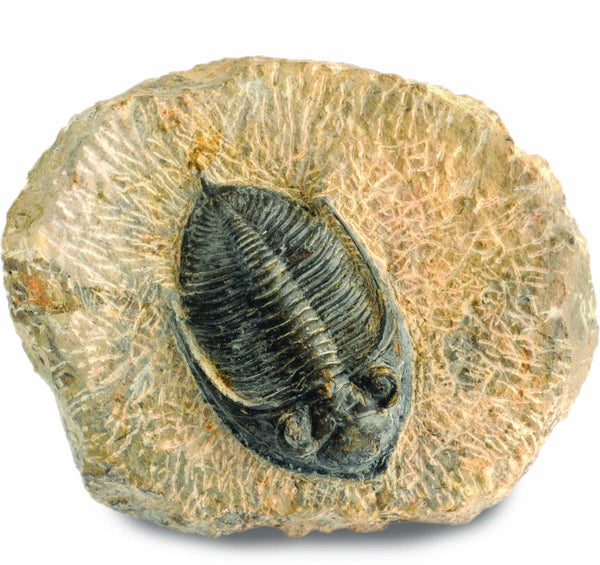
For fun, my husband and I have always followed the traditional themes for gifts marking significant wedding anniversaries, starting with paper, when he gave me a (still treasured) subscription to the New York Times. On our 20th, I was at first stumped by “china.” We already had plates. Maybe, I thought, I could focus on the place rather than porcelain? Horizons opened, and I settled on bestowing on him a 380-million-year-old former denizen of China: a fossil trilobite. My husband was delighted; we both enjoyed reflecting on the symbolism of the arthropod’s enduring journey on the earth.
Complex multicellular organisms such as trilobites burst onto the scene during the Cambrian explosion, starting 540 million years ago. The unevenness of fossilization, weathering and other processes, however, have made it difficult to see to the roots of these life-forms. Recent discoveries in Siberia, Namibia and other places are now showing that complex animals actually got their start millions of years before the Cambrian period. As geoscientist Rachel A. Wood of the University of Edinburgh writes in her cover story, “The Rise of Animals,” new geochemical techniques are also helping us understand why Cambrian fossils emerged when they did. Join Wood in her tale about how she and other researchers are gaining a deeper appreciation of these ancient epochs.
Time’s a-wasting, as the saying goes, for action on climate change today, as will become obvious when you read “Rough Weather Ahead,” by Jennifer Francis of the Woods Hole Research Center in Falmouth, Mass. Specific extreme weather events are worsened by climate change, scientists can now show. More heat in the ocean and more heat and vapor in the atmosphere are affecting weather globally. Regional effects play roles as well, including an expanding tropical zone, a “cold blob” in the Atlantic Ocean and disruptions in the polar vortex.
On supporting science journalism
If you're enjoying this article, consider supporting our award-winning journalism by subscribing. By purchasing a subscription you are helping to ensure the future of impactful stories about the discoveries and ideas shaping our world today.
Theories—in the scientific sense, explanations for observational evidence—around evolution and climate change have been met with skepticism in certain circles. Vaccines, thanks to a paper retracted years ago claiming a false link to autism, have also had critics. It’s tempting to feel superior to the unconvinced, given the long-standing supporting evidence that documents how life evolves through random mutations and natural selection; anthropogenic activities are shifting the climate; and inoculations prevent disease without causing autism.
The process of research, as rational as it is, can nonetheless take time to clarify any given question. In “Vaccines Reimagined,” contributing editor Melinda Wenner Moyer looks at the controversial idea that one immunization, given properly, can protect against many diseases besides its target. Is it right? Only time will tell.