
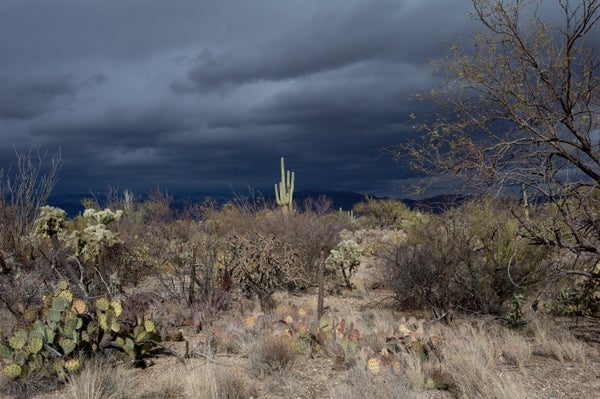
Even desert plants have their limits.
As dryland ecosystems experience stronger heat waves and droughts, scientists have wondered how climate change might affect the hardy plants that thrive in harsh deserts or dry mountains.
With about 40% of the world covered in dry land, the question carries enormous weight for conservation policy: Will the natural toughness of those plants prepare them for even more extreme conditions? Or have they already reached the limits of what they can endure?
On supporting science journalism
If you're enjoying this article, consider supporting our award-winning journalism by subscribing. By purchasing a subscription you are helping to ensure the future of impactful stories about the discoveries and ideas shaping our world today.
Recent research suggests dry lands are at a breaking point — and it's more closely tied to temperature than previously thought.
Dryland ecosystems "may be more susceptible to climate change than expected," a group of University of California, Irvine, researchers wrote in a recent study based around Anza-Borrego Desert State Park near the Mexican border.
"Our analysis suggests these ecosystems may have crossed an ecological threshold," they said, describing a breakdown in the relationship between precipitation and vegetation cover beginning around 1999.
In the Sonoran Desert and nearby landscapes, the scientists found, vegetation cover declined much more sharply than drought or wildfires alone could explain. Satellite observations between 1984 and 2017 showed "widespread" declines in perennial vegetation cover, the researchers wrote, especially in lowland deserts.
In the lowlands, modeling revealed that temperature explained much of the desert's vegetation change, according to the study. Rising heat was also the best explanation for vegetation declines over the long term, as precipitation and wildfires have swung wildly from year to year.
The importance of heat surprised even the researchers.
"Many plant species in desert ecosystems have adaptations that allow them to withstand high temperatures, making this observation somewhat unexpected," they wrote.
More research is needed to explain the mechanism behind that relationship, the authors added. One possible reason is that hotter weather makes water evaporate more quickly, creating even worse water stress on plants during the hot summer months.
The implications of the research could be dire.
Drought conditions have caused mass plant death in Southern California. That has changed the way the ecosystem responds to climate shifts, the researchers wrote. Notably, it seems to have broken down the once-predictable relationship between rain and vegetation cover.
"One potential implication is that it will be very difficult to predict future responses to changing environmental conditions. This could pose an important limitation to our ability to understand how drylands will be affected by future climate change," they wrote.
Reprinted from E&E News with permission from POLITICO, LLC. Copyright 2021. E&E News provides essential news for energy and environment professionals.