
The question on the physics quiz seemed simple enough: “What is the smallest piece of matter that makes up everything in the universe?”
Binta's response: “Binta.”
I laughed out loud. You would, too, if you saw tiny Binta, who is one of my smartest seventh graders. Surely she knew the correct answer is “atom.” Yet, I mused, a famous equation governing atoms could also apply to her.
On supporting science journalism
If you're enjoying this article, consider supporting our award-winning journalism by subscribing. By purchasing a subscription you are helping to ensure the future of impactful stories about the discoveries and ideas shaping our world today.
E = mc2. The equation says that under the right conditions, mass can become energy, and vice versa. Because light moves so fast, an atom at rest—even with a small mass—contains a great deal of energy. A walnut has enough energy locked in it to power a small city. Mass from the sun radiates as light that warms the earth from 93 million miles away. Tiny masses hide astronomical energy.
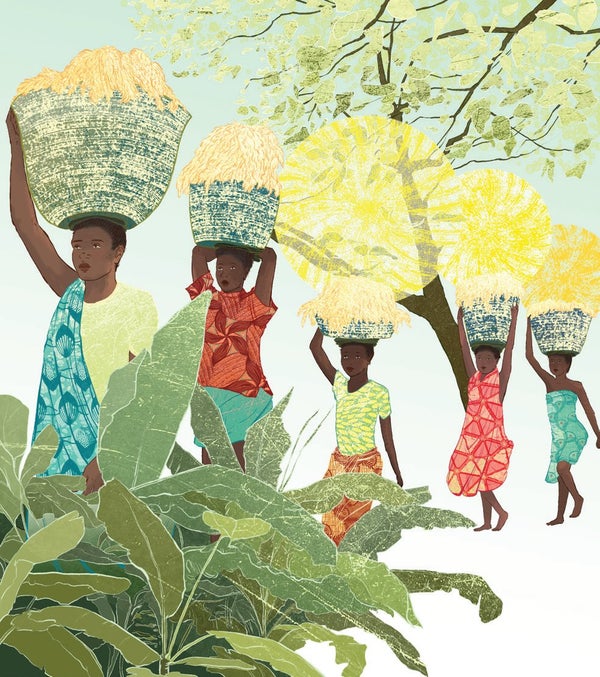
Reflecting on Binta's lesson as I walk home through the village, I am almost knocked over by Aissatou's exuberant tackle-hug. A magical six-year-old with a spirit too big to fit her child's body, Aissatou is further evidence of the small but powerful. A year into my Peace Corps service in Guinea, my young neighbor has become my local language teacher, running partner, closest friend and inspiration. I’ve watched her lead friends through dances she created, make bandages from spare fabric for her injured four-year-old sister and fashion a rope extension so our bucket can reach the bottom of our dried-up well. Aissatou is a designer: she builds, plays and imagines. I observe her ingenuity with awe.
I see Aissatou the way my parents saw me: filled with unlimited potential. My parents called their four kids “their greatest collaboration” and helped us grow into our fullest selves. Knowing the challenges facing young women in physics, Dad went out of his way to fuel my passion. Once he drove me six hours to a lecture by a female physicist. His encouragement emboldened me to dive into a challenging field dominated by men.
Aissatou, on the other hand, has been taught that she should be dominated by men. When male visitors arrive at her house, the jubilant builder I know transforms into a meek and submissive servant, bowing as she acquiesces to their every request.
The difference? I won the lottery at birth: time, place and parents who gave me the chance to develop my passions. I am on a mission to give Aissatou and Binta the chance to do the same.
I think about the untapped potential of millions of girls like Aissatou and Binta, who lack opportunities because of custom, poverty, laws or terrorist threats. The gifted young women I’ve taught as a Peace Corps volunteer implementing the Let Girls Learn program have strengthened my conviction that it is possible for them to fulfill their promise through education. And educating girls is not only morally right but also provides a cornerstone of achieving a peaceful and prosperous future.
I wonder if Binta intended to leave me the clue to a brighter world in her quiz. After all, I reflected on moral metaphors in science when I was her age.
“What exciting thing did you learn today?” my dad would ask.
“We should all be like ideal gases,” I responded one day after an exciting physics class. “They expand to fill whatever containers they occupy, so we can make the most of every situation too.”
He smiled knowingly. “You know, gases with enough energy can even break open their containers.”
When I see Aissatou squeal joyously on the improvised roller coaster she built from tree branches, I know that with the right support she could burst through her cultural container. If anyone has enough energy, she does.
Do you want to know something exciting I learned? Mass-energy equivalence means that the solar energy striking the earth each second equals only four pounds of mass. That means a small girl of 40 pounds could unleash the energy of 10 suns shining on the earth in a second. Take the 132 million girls who are not in school, and we have 1.32 billion suns in our daughters.
How will we help them rise?