
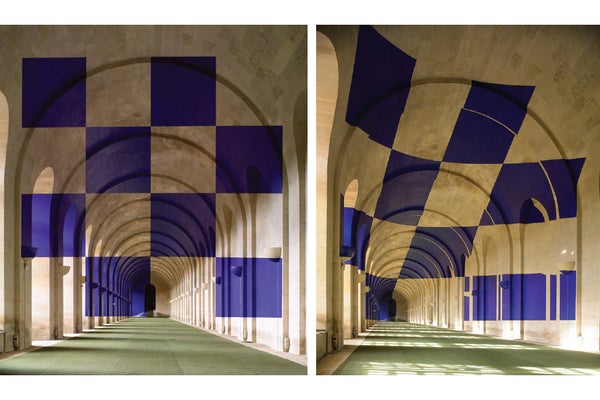
The life of our city is rich in poetic and marvelous subjects. We are enveloped and steeped as though in an atmosphere of the marvelous; but we do not notice it.
—Charles Baudelaire, 1846
Urban landscapes are embodiments of human aspirations and dreams. They represent the spirit of an age and personify the minds and hearts of the people who inhabit them. Archaeological excavations of ancient cities, such as the magnificently preserved ruins of Pompeii and Herculaneum, bring to life our distant past. If we could peer into the future, we would want to know what our cities will look like to understand who we will become.
Cities capture our imagination in fascinating ways. Art and folklore are chock-full of mythical and imaginary cities, from the sunken lost city of Atlantis and El Dorado's city of gold to Fritz Lang's dystopian film Metropolis and, more recently, the Escheresque architecture of the folding cityscapes in the movie Inception. Yet we need not turn to fiction or travel far in space or time to experience the wonder. Even the most desolately functional urban environments can be sprinkled with nuggets of magic and surprise, with illusion “Easter eggs” that challenge our perception of what's real.
On supporting science journalism
If you're enjoying this article, consider supporting our award-winning journalism by subscribing. By purchasing a subscription you are helping to ensure the future of impactful stories about the discoveries and ideas shaping our world today.
Our everyday cities are not all that they may seem. Oftentimes it's a matter of perspective.
CHILDREN CROSSING

COURTESY OF COMMUNITY AGAINST PREVENTABLE INJURIES
One practical application of anamorphic perspective is roadway writing. The abnormally elongated shape of warnings such as “children crossing” allows drivers to read them easily as they approach the text. British Columbia–based safety-awareness group Preventable has pushed this concept to the limit, hoping to change drivers' attitudes in a guerrilla marketing campaign. The group's 45-foot illusion, which portrays a young girl chasing a ball across a busy intersection, stayed for a week near a school in West Vancouver. When drivers approached the image, the girl's shape started to form from about 50 feet away and remained three-dimensional for another 40 feet.
HONEY, I SHRUNK THE STADIUM

COURTESY OF GREG KEENE
We turn from the massive to the minute. Miniature faking via digital postprocessing can turn a crowded stadium into a game of foosball. In this technique, a small selected portion of the image remains sharp, whereas the other regions are blurred to various degrees, simulating the shallow depth of field of close-up photography. The resultant image looks like the photograph of a miniature scale model, rather than an actual scene.
AN INVISIBILITY CLOAK OF PAINT

COURTESY OF UNIVERSITY OF CENTRAL LANCASHIRE
Some illusions make objects appear, such as floating squares. Others make them disappear. Sara Watson, then a student at the University of Central Lancashire in England, devised a spectacular vanishing act as part of her drawing and image-making course. She gave an old Skoda a new paint job that made it invisible by allowing it to blend in with the background like a chameleon. Urban camouflage at its finest.
HAUNTED HOUSE

COURTESY OF WWW.URBANSCREEN.COM
Projection mapping is a recent technique for artistic expression, which provides the illusion of movement in stationary objects such as large buildings. The 3-D aspects of the end product are equally remarkable. By adding shading and subtle size changes to the projected objects, the artists induce a powerful feeling of depth and volume that our visual neurons can't resist. This piece, produced by Urbanscreen and projected on the Galerie der Gegenwart at the Hamburger Kunsthalle art museum in Germany, is entitled How It Would Be If a House Was Dreaming. Watch the video at www.urbanscreen.com/555-kubik
LARGER THAN LIFE

COURTESY OF JORGE RODRÍGUEZ-GERADA www.jorgerodriguezgerada.com
Artist Jorge Rodríguez-Gerada used the smallest materials, grains of sand, to create Expectation, a gargantuan portrait of Barack Obama spanning 2.5 acres of beachfront in Barcelona, Spain. The president's likeness is imperceptible at human eye level (bottom), but from a bird's-eye view (top) the picture comes alive. Sandpainting—especially at a gigantic scale—is a form of pointillism, the technique used by painters such as Georges Seurat, Paul Signac and Vincent van Gogh, in which the juxtaposition of multiple individual points creates patterns and shades of color that become apparent only from afar.
The illusion works as long as the image of every element (dot of paint, grain of sand) on the retina is roughly equal to the size of a photoreceptor. Our retina sees the world as a field of photoreceptor points of light, whether they were drawn that way or not, which makes viewing distance critical to our perception of texture. The fine details of wood grain and other textures are visible only up close, when they fall directly on our fovea, the central region of each of our retinas, where photoreceptor density is highest. Our photoreceptors are unable to resolve the subtle differences in color or shape of an object when we step away, so the coarser features of the image dominate our perception instead.