
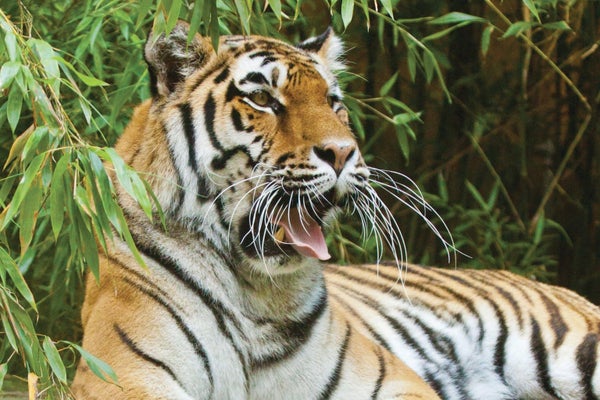
In 2003 a young Amur tiger, seeming disoriented, wandered into a Russian village on the Chinese border. Wildlife Conservation Society scientists anesthetized the tiger and determined that she had canine distemper—the first case confirmed in a wild tiger. The feline patient zero died six weeks later.
Since then, canine distemper, an untreatable virus that can infect many types of carnivores, has spread among Amur tigers across the subspecies' range in Russia's far east. An exhaustive new analysis suggests that if the virus runs its course, it could wipe out a key population of these endangered cats. But this risk can be lessened, the researchers found, by vaccinating the tigers.
“We found that distemper does have the capacity to impact wild tiger populations, particularly smaller ones, quite profoundly,” says Martin Gilbert, a wildlife veterinarian and epidemiologist at Cornell University and lead author of the study in the Proceedings of the National Academy of Sciences USA. Small populations of other susceptible species could be threatened as well, he adds.
On supporting science journalism
If you're enjoying this article, consider supporting our award-winning journalism by subscribing. By purchasing a subscription you are helping to ensure the future of impactful stories about the discoveries and ideas shaping our world today.
To predict distemper's long-term effects, the team simulated disease dynamics in the region's two main tiger populations, which have about 500 and 30 animals, respectively. The researchers found distemper increases extinction risk in the next 50 years by 65 percent for the smaller tiger population—whose range makes it critical for potentially repopulating the animals in northeastern China.
By comparing the disease's genetic sequences in various species, the researchers also found that the tigers primarily get distemper from other wild animals, so vaccinating domestic dogs—often assumed the disease's main reservoir—would not be enough. But vaccinating just two tigers from the smaller population per year during routine monitoring work would reduce the group's extinction risk by 75 percent.
“I think distemper vaccination definitely has a role in assisting small, isolated tiger populations at risk, such as those described in the Russian far east,” says Edward Ramsay, a professor emeritus of zoological medicine at the University of Tennessee, who was not involved in the research. “Studies have shown the vaccines are safe, and experience with Asian lions in India demonstrates that even an incomplete vaccination program can help prevent deaths.”
But gaining support could be challenging. “There is still considerable uncertainty among wildlife managers around vaccination as a conservation tool,” says study co-author Sarah Cleaveland, a University of Glasgow veterinary surgeon and comparative epidemiologist. “We hope that our research will address some of the issues around the scientific uncertainties, but as with vaccine hesitancy in the human health field, there is also misinformation and quite a lot of unwarranted concern about the risks of vaccination in wildlife.”