
Editor’s Note (1/11/17): Update: A presidential transition national spokeswoman has said that the president-elect would like to a form a commission on autism, but no final decision has been made.
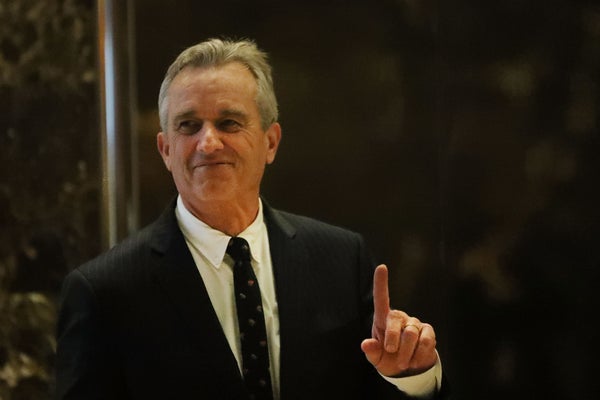
WASHINGTON—Outspoken vaccine critic Robert Kennedy Jr. has accepted a position within Donald Trump’s administration as chair of a panel on vaccine safety and scientific integrity—the clearest sign yet of the president-elect’s suspicions about vaccines.
The offer, which came in a Wednesday meeting between Trump and the scion of America’s most prominent Democratic family, is likely to concern scientists and public health experts who fear the incoming administration could give legitimacy to skeptics of childhood immunizations, despite a huge body of scientific research demonstrating that vaccines are safe.
On supporting science journalism
If you're enjoying this article, consider supporting our award-winning journalism by subscribing. By purchasing a subscription you are helping to ensure the future of impactful stories about the discoveries and ideas shaping our world today.
“President-elect Trump has some doubts about the current vaccine policies and he has questions about it,” Kennedy told reporters after the meeting. “His opinion doesn’t matter but the science does matter and we ought to be reading the science and we ought to be debating the science. And that everybody ought to be able to be assured that the vaccines that we have—he’s very pro-vaccine, as am I—but they’re as safe as they possibly can be.”
Kennedy has repeatedly questioned the safety of vaccines and advanced arguments that there is a link between the immunizations and autism. He has suggested that thimerosal, a mercury-based preservative used in vaccines, can be harmful to children, a notion that has been widely debunked.
Public health agencies did suggest manufacturers eliminate or reduce the amount of thimerosal in vaccines and many have done so. But a number of studies have also discredited the idea of thimerosal is a cause of autism.
Kennedy’s work on autism has created controversy over the years. In 2005 he wrote an expose, co-published by Salon and Rolling Stone, contending that scientists were hiding the link between thimerosal and autism. Years later, Salon retracted the story, noting its basic thesis was inaccurate. Rolling Stone deleted it.
But Kennedy was not finished with the subject. He edited a 2014 book called “Thimerosal: Let the Science Speak: The Evidence Supporting the Immediate Removal of Mercury—a Known Neurotoxin—from Vaccines.” The volume makes the case that thimerosal is still causing autism and other neurological problems, and should be eliminated worldwide.
While Trump’s casual remarks on vaccines have alarmed public health advocates, they have energized the anti-vaccination movement. He met over the summer with Andrew Wakefield, a former medical doctor who wrote a well-publicized study that kicked off the movement. Wakefield’s study was later discredited and his medical license was revoked.
During the presidential campaign, Trump said he wants “smaller doses over a longer period of time.” He has previously tweeted: “Healthy young child goes to doctor, gets pumped with massive shot of many vaccines, doesn’t feel good and changes – AUTISM. Many such cases!”
Kennedy is the son of the former attorney general and nephew of the late President John F. Kennedy.
Republished with permission from STAT. This article originally appeared on January 10, 2017