
By Tom Miles
GENEVA, May 10 (Reuters) - A major yellow fever outbreak in Angola and two smaller flare-ups in Uganda and Congo are largely under control but countries have been warned to be vigilant in case the disease pops up elsewhere, the World Health Organization (WHO) said on Tuesday.
Yellow fever is hard to spot early on and spreads quickly in towns, transmitted by the same mosquito that carries the Zika virus, which bites in the daytime and has flourished during the abnormal El Nino weather of the past year caused by the warming of the Pacific Ocean off the coast of South America.
On supporting science journalism
If you're enjoying this article, consider supporting our award-winning journalism by subscribing. By purchasing a subscription you are helping to ensure the future of impactful stories about the discoveries and ideas shaping our world today.
"What we hope is that El Nino will not be faster than we are," said Sylvie Briand, head of WHO's department of pandemic and epidemic diseases.
"We are concerned for other countries that have high densities of mosquitoes."
Until the development of the highly effective vaccine, yellow fever changed history, Briand said, with outbreaks delaying construction of the Panama Canal and encouraging Napoleon to give up territorial ambitions in North America.
In Angola's capital Luanda, the first cases were at a roadside restaurant six months ago, when a group of friends fell ill with suspected food poisoning and several died. Only when the restaurant owner died was the alarm raised.
Angola has had 2,267 suspected cases and 293 deaths. Of the cases, 696 have been confirmed, including 445 from Luanda province. Democratic Republic of Congo has had 41 confirmed cases, almost all of them imported from Angola, but the outbreak was discovered early and should be stopped quickly, Briand said.
Uganda, which has seven confirmed cases in rural areas, was also well set up to tackle such outbreaks, she said.
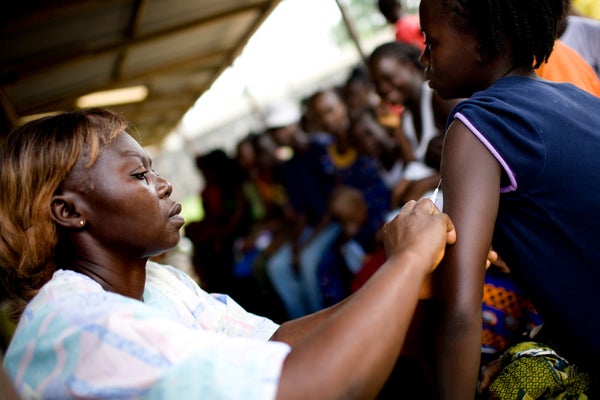
Luanda's population is now almost completely vaccinated, but it used up the world's entire emergency stockpile of vaccines, and the slow vaccination campaign allowed the virus to spread to other provinces.
"The vaccine supply, which is usually sufficient, may become stretched if we have more outbreaks in the coming months," Briand said.
An early risk is Angola's population of foreign oil workers, who are in danger of taking the disease home with them.
Portugal and China, which both have strong links to Angola, have both taken the right steps to protect themselves, Briand said.
But many countries in Africa do not have vaccination coverage for children, and Nigeria, which suffered thousands of yellow fever deaths in a multi-year outbreak in the 1980s, was still "definitely a country at risk", Briand said.
"We hope to be able to vaccinate everybody before there's a case."